

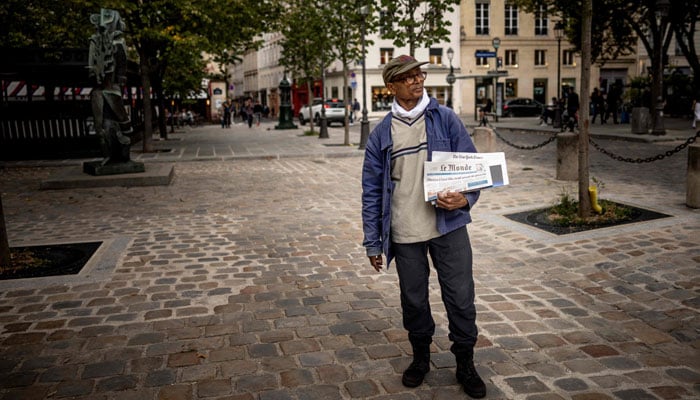
PARIS, FRANCE – In the bustling heart of the French capital, a dwindling profession finds its last, resonant voice in Ali Akbar, a 73-year-old newspaper hawker whose humorous shouts and enduring presence have made him a living legend. Zigzagging daily through the upscale streets and cafes of Saint-German-des-Pres, Akbar is known to everyone, and everyone knows him.
Operating primarily in the Left Bank, the cultural and intellectual epicentre of Paris, Akbar’s signature is his repertoire of invented, sensational headlines designed to amuse and engage. “France is getting better!” he cries, alongside political barbs like, “(Eric) Zemmour has converted to Islam!”—a pointed reference to the far-right candidate in the 2022 presidential elections.
Locals and tourists alike often stop, captivated by the slim, fine-featured figure with round spectacles and a Gavroche cap who carries bundles of the French daily Le Monde under his arm.
Amina Qissi, a waitress opposite the Marche Saint-Germain who has known Akbar for more than 20 years, attests to his status: “Even the walls could talk about Ali. Even regular tourists ask where he is if they don’t see him.”
A Life of Hardship and Recognition
In recognition of his “dedicated service to France,” President Emmanuel Macron has pledged to soon make Akbar a knight in the national order of merit, one of France’s highest honours.
Akbar, a Pakistani immigrant, initially reacted with surprise. “At first, I didn’t believe it… I believe it’s related to my courage, because I’ve worked hard,” he said, noting he often crossed paths with Macron when the future president was a student.
Akbar’s journey to the Parisian streets was paved with significant hardship. Arriving in France at the age of 20 to escape poverty and support his family in Pakistan, he initially worked as a sailor and then a dishwasher in Rouen.
His life changed in Paris after he encountered the humourist Georges Bernier (Professeur Choron), who offered him the opportunity to sell his satirical newspapers Hara-Kiri and Charlie Hebdo. Akbar has endured homelessness, extreme poverty, and even physical attacks, but he maintains he has never given up.
“Emmanuel Macron is going to put a bit of antiseptic on my wounds,” he remarked to his son, Shahab, who describes himself as “very proud” of his father and often catalogues the numerous profiles dedicated to him in the foreign press.
In the 1970s, the Latin Quarter was Akbar’s primary focus—a university area where he recalled learning French by interacting with students, including former Prime Minister Edouard Philippe and “many others who became ministers or lawmakers.”
The Changing Rhythm of the City
Paris once had about 40 newspaper hawkers—street vendors without fixed newsstands. Akbar distinguished himself by choosing to walk a route, often inventing sensational headlines since the 1980s.
“I want people to live happily. I do it to create a good mood, that’s all,” he explained. Yet, he admits the humour is harder to find now: “Everything is such a mess.”
Despite receiving a pension of 1,000 euros ($1,175) a month, Akbar continues to work every day from 3 pm until 10 pm. When met on a recent afternoon, the pace was slow. He now sells an average of about 30 newspapers daily, a stark contrast to the 150 to 200 he sold when he started.
“As long as I’ve got the energy, I’ll keep going. I’ll work until I die,” he quipped, underlining his deep commitment to his profession.
For patrons like Amel Ghali, 36, Akbar is “inspiring.” Ghali reflected on the value of his enduring trade: “It’s good to see it in the digital age. Unfortunately, our children won’t experience the pleasure of reading a newspaper with a coffee.”
