

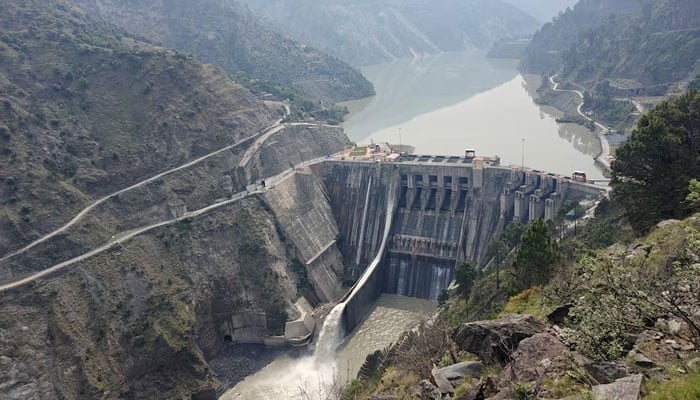
Breaking a long silence since their May military standoff, India has reached out to Pakistan through the Indus Waters Treaty (IWT), sharing details on potential flood threats. Official sources revealed on Monday morning that New Delhi warned Pakistan of a possible major flood in the Tawi River at Jammu. The Indian High Commission in Islamabad conveyed the alert in a communication made on the morning of Sunday, August 24. This is the first significant contact of its kind since the Pakistan-India war in May, according to sources. Following the alert, Pakistani authorities issued warnings based on the information provided by India.
In the wake of the killing of 26 people in the Pahalgam area of Indian Illegally Occupied Jammu and Kashmir (IIOJK) in April, India had held the IWT with Pakistan in abeyance. New Delhi accuses Islamabad of orchestrating the deadly militant attack, an allegation that Pakistan denies. Based on these baseless allegations, India waged a war against Pakistan in May, resulting in the heaviest military engagement in decades, before a ceasefire was brokered by the US. The nuclear-armed neighbors disagree over the use of water from rivers that flow downstream from India into the Indus River basin in Pakistan.
What is the Indus Waters Treaty?
The use of the water from the Indus River system is governed by the IWT, which was mediated by the World Bank and signed by both nations in September 1960. The agreement divided the Indus and its tributaries between the two countries, regulating water sharing. India was granted the use of water from the three eastern rivers—Sutlej, Beas, and Ravi—while Pakistan was allocated most of the water from the three western rivers—Indus, Jhelum, and Chenab. There is no provision in the treaty for either country to unilaterally suspend or terminate the pact, which has clear dispute resolution systems.
What are the concerns over water?
The countries have argued and disputed several projects on the Indus and its tributaries for years. Pakistan is heavily dependent on this river system for its hydropower and irrigation needs. It claims that India unfairly diverts water through the construction of upstream barrages and dams, a charge India denies. Pakistan is concerned that India’s dams will cut flows on the river, which supplies water to 80% of its irrigated agriculture. It has requested a neutral expert and then an arbitration court to intervene in two recent hydropower projects. India has accused Pakistan of dragging out the complaints process and maintains that the construction of its Kishanganga and Ratle hydroelectric projects is permitted under the treaty. It has also sought modification of the pact to address such delays.
What could a suspension change?
A suspension of the treaty is not expected to have an immediate impact on the flow of water to Pakistan, as India lacks sufficient storage capacity. However, water at a key receiving point in Pakistan briefly fell by as much as 90% in early May after India began maintenance work on some Indus projects. India’s move could also introduce uncertainty into Pakistan’s agricultural system. Indian officials have said that a suspension would allow India to stop sharing crucial information and data on water releases from barrages and dams, and that New Delhi would no longer be obligated to release minimum amounts of water during the dry season.
How has Pakistan reacted to the decision?
Pakistan argues that the treaty is a binding international agreement brokered by the World Bank and contains no provision for unilateral suspension. Ghasharib Shaokat, the head of product at Pakistan Agriculture Research, called the treaty the backbone of the country’s agriculture sector. “It puts our agricultural future on shaky ground. If water flows become erratic, the entire system takes a hit—especially irrigation-dependent crops such as wheat, rice, and sugarcane,” Shaokat said. “Yields could drop. Costs could rise. Food prices would likely spike. And small-scale farmers, who already operate on thin margins, would bear the brunt of it.”
Khalid Hussain Baath, chairman of a national farmers’ union in Pakistan, described the move as an act of belligerence. “This is a true war,” Baath said from Lahore. “We already have a water shortage because of climate change. Low rainfall this year, and limited snow, means that the water level is already 20-25% lower than last year.”
A key win in The Hague court
In a major victory, the Permanent Court of Arbitration in The Hague in June issued a Supplemental Award in the IWT case, ruling in favor of Pakistan. According to a government statement, Pakistan reiterated its commitment to resolving the issue under the IWT framework and stressed the need for renewed diplomatic engagement between the two countries. The arbitration court’s ruling confirmed that India’s unilateral actions could not undermine the jurisdiction of either the court of arbitration or the Neutral Expert in proceedings under the IWT. “The Court has affirmed its competence in light of recent developments and that unilateral action by India cannot deprive either the Court or the Neutral Expert… of their competence to adjudicate the issues before them,” the statement read.
Following the award, Pakistan called on India to immediately resume the normal functioning of the IWT and to fully and faithfully honor its treaty obligations. “In a supplemental award announced on June 27, 2025, the Court hearing the Pakistan-India dispute over the Kishenganga and Ratle hydroelectric projects has found that its competence remains intact, and that it has a continuing responsibility to advance these proceedings in a timely, efficient, and fair manner,” the Foreign Office (FO) said in a statement. “The Court of Arbitration decided to announce this supplemental award in the wake of India’s illegal and unilateral announcement to hold the Indus Waters Treaty in abeyance,” it added.
