

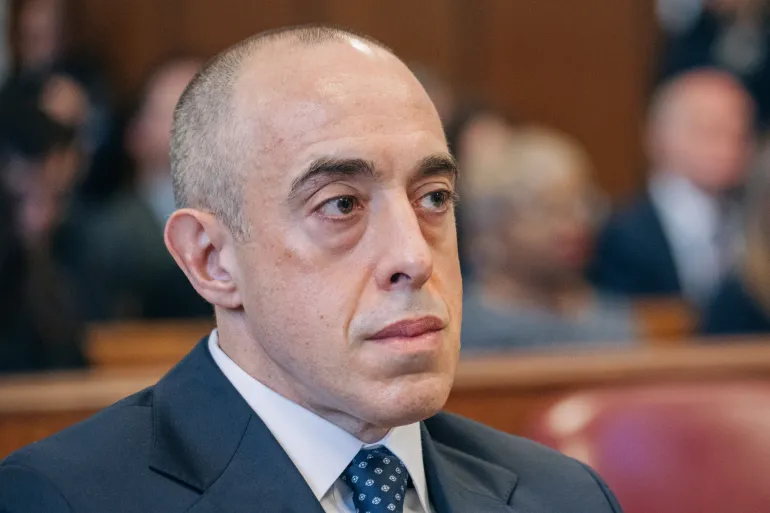
While US presidents possess extensive powers to nominate federal judges, some view Bove as a precursor to more ideologically driven appointments during Trump’s second term. Critics have characterized Trump’s actions as an attempt to sculpt the judiciary in the image of his Make America Great Again (MAGA) movement.
On Tuesday, the Republican-controlled Senate secured a simple majority, 50 to 49, to confirm Bove’s seat on the US Third Circuit Court of Appeals. With only two Republicans voting against the confirmation, some observers perceive little political will within the party to curb Trump’s actions.
Gregg Nunziata, the executive director of the Society for the Rule of Law, a conservative legal group, wrote in a letter to members of the Senate Judiciary Committee in June, “This nomination threatens to portend a broader turn toward the appointment of result-oriented loyalists to the judiciary.” He urged lawmakers to oppose Bove’s nomination. “In Mr. Bove, the president believes he has found his MAGA warrior.”
Why is Bove Controversial?
Despite a multitude of firebrand nominations, Trump’s decision to select Bove stands out. This is partly due to the longevity of the appointment, which will see the 44-year-old lawyer exert influence over federal appeals cases for decades in a region encompassing Maryland, New Jersey, and Pennsylvania.
Prior to joining Trump’s second term, Bove served as the president’s personal lawyer, unsuccessfully defending him against criminal charges in New York. However, on January 20, Trump’s first day back in office, he designated Bove as acting deputy attorney general. His actions in that capacity have ignited outrage over what critics have termed Bove’s abysmal ethics record.
During his nearly six-month tenure, Bove has been the subject of at least three whistleblower complaints. Some of these complaints relate to allegations that Bove sought to terminate the federal prosecution of New York City Mayor Eric Adams in exchange for a crackdown on migrants in the city – and that he subsequently misrepresented this to the Senate. Meanwhile, two of the whistleblowers reported that Bove instructed members of the Department of Justice to defy court orders that ran contrary to Trump’s policies. Bove’s comments allegedly included advice to tell courts “f*** you” if they opposed Trump’s deportation efforts.
US media has further reported that Bove spearheaded a purge at the Justice Department against Trump’s perceived political opponents. These included career government employees involved in the prosecution of rioters who stormed the US Capitol on January 6, 2021.
During his Senate hearing, however, Bove categorically denied acting as Trump’s “henchman.” Still, Senator Lisa Murkowski, one of the two Republicans who opposed the confirmation, stated that the evidence presented in the chamber depicted Bove as “somebody who has counseled other attorneys that you should ignore the law, you should reject the law.” Murkowski added, “I don’t think that that individual should be placed in a lifetime seat on the bench.”
Democrat Sheldon Whitehouse, in an interview with MSNBC after Bove’s confirmation, offered a more direct assessment: “This is a genuinely bad guy.”
A New Strategy?
In his first term, from 2017 to 2021, Trump had already contributed to transforming the US judiciary, appointing a total of 226 federal judges. These included 54 appellate judges and three justices to serve on the nine-member Supreme Court. These appointments, largely based on chance vacancies, were almost always drawn from a pool of candidates approved by conservative groups like the Federalist Society. That organization has aimed to reshape the country’s legal landscape with a rightward leaning.
The Federalist Society states it advocates for “individual liberty, traditional values, and the rule of law,” and it has played a role in laying the groundwork for significant conservative victories, including the overturning of Roe v. Wade, the landmark ruling that had protected the nationwide right to abortion access.
However, early this year, Trump signaled a departure from the group, lashing out at its former leader, Leonard Leo, whom he called a “sleaze bag” and a “bad person who, in his own way, probably hates America.” Trump contended that Leo had given him “bad advice,” leading him to appoint a Federalist Society-approved judge during his first term. That judge was among a panel that ruled against the president’s signature tariff policy in May.
While the Federalist Society has been conspicuously silent on Bove’s nomination, legal experts from both conservative and left-leaning circles have questioned whether his allegiance to Trump would overshadow his commitment to jurisprudence.
Nunziata, from the Society of the Rule of Law, wrote that Trump’s past judicial appointees generally exhibited “judicial excellence and a commitment to the rule of law.” He explained, “Many of them have proven their mettle in contentious litigation involving the president or his policies.” But he proceeded to describe Bove’s conduct as “unthinkable” for a federal judge. He wrote, “The Bove nomination represents a stark and apparently intentional break from this successful model and should raise concerns across the ideological spectrum.”
The progressive Alliance for Justice expressed a similar sentiment, writing that Bove’s “allegiance lies not with civil rights or the rule of law but with Trump and his authoritarian agenda to expand executive power far beyond the limits set by the Constitution.” “Emil Bove’s record makes clear he is unfit for a lifetime seat on the federal bench.”
What Lies Ahead?
Trump’s attacks on the federal judiciary – targeting judges appointed by both Republicans and Democrats alike – have been unprecedented. Judges have openly speculated that the Trump administration may be found in contempt for disregarding court orders. And Trump himself has openly criticized judges as “deranged” or “lunatic” for opposing his policies.
However, it remains uncertain if Trump’s abrasive approach to the judiciary will manifest in more controversial appointments like Bove. Some analysts noted that Trump has generally nominated judges from the more traditional conservative pipeline. It remains to be seen if Bove will be an exception or the beginning of a new trend.
Just this week, the Trump administration indicated it may continue to adopt an aggressive stance in its approach to the judiciary. For example, the Justice Department filed a complaint on Monday seeking to censure US District Court Judge James Boasberg, who attempted to block Trump-ordered deportation flights in March. The complaint accused Boasberg of making inappropriate comments about the president’s administration, but critics view it as an effort to discredit a judge who has issued high-profile rulings against Trump.
On the day of Bove’s appointment, Trump also targeted a Senate custom that affords the minority party – in this case, the Democrats – an opportunity to block some lower-level federal judicial and prosecutorial nominations.
Under the so-called “blue slip” tradition, lawmakers are given the ability to veto the confirmation of federal district judges or federal prosecutors who will serve in their state. This practice, more akin to a gentleman’s agreement than an official policy, has long been regarded as one of the last remnants of bipartisanship in the US legislature.
While the custom does not apply to higher federal judges, including appellate or Supreme Court justices, its elimination would facilitate Trump’s ability to more fully assert his influence over all levels of the federal judiciary. On Truth Social, Trump called upon Republican senators to end the tradition, which he deemed “ancient and probably Unconstitutional,” as well as a “hoax.” With the “blue slip,” he added, Democrats “have an ironclad stoppage of Great Republican Candidates.” Republican leaders in the Senate, however, have voiced reluctance to terminate this tradition.
