The Dr. Imran Farooq Case, the Fear of Reconciliation With Altaf Hussain, and the Establishment’s Real Test
By Raja Zahid Akhtar Khanzada
In Karachi’s politics, truth has always walked barefoot, while noise runs ahead wearing heavy boots. Noise gathers crowds. Truth gathers time. During the harsh years of authoritarian rule, it became clear that resistance was treated as a crime and silence as survival. Yet those same dark years left behind a lasting lesson: power does not always stand with truth. But truth, even if delayed, eventually makes space for itself.
Over this long journey, the games of the establishment have repeatedly unfolded before our eyes. At times, someone is embraced; at others, the same person is pushed against the wall. The fate of the political favorite has often been political orphanhood. Yesterday’s favorites become today’s outcasts, and yesterday’s outcasts are recast as today’s favorites.
Despite all these reversals, one standard has remained constant across eras, and I have observed it closely. Whether in the Pakistan Peoples Party, the Muslim League, or the Muttahida Qaumi Movement, being “from a family,” being loyal, and being faithful has always been the measure. Here, being “from a family” does not signify feudal lineage or wealth. The poor, too, can be from a family, and often it is the poor who embody it most fully. Such a person has little to sell except conscience. Sacrifice becomes their ornament, loyalty their identity. Someone who breaks the salt bowl after eating the salt, who cuts down the tree that once gave shade, may succeed temporarily in politics, but morally, such a person never truly prevails, nor do they ever find a home in the public’s heart.
It is through this lens that I view Mustafa Kamal’s recent press conference. I do not see it as news. I see it as a case study in political psychology. It was a press conference where anger overwhelmed argument, where language lacked restraint, and where accusations were hurled with confidence but without evidence. To wrap an allegation of murder in words like intoxication, birthdays, and gifts is not merely political accusation. It crosses the basic boundaries of human decency.
The intense trolling Mustafa Kamal has faced on X from thousands of users is increasingly reflective of where public opinion stands. People are not accepting this narrative. That is why social media continues to raise a central question: how is it that those whom he once accused so fiercely have now become his political leaders? Old tweets and videos of Mustafa Kamal are being widely shared, reminding the public that he once accused not only Altaf Hussain but also Khalid Maqbool Siddiqui of being agents of Indian intelligence. Those videos exist. Yet today, he stands at the forefront of political alignment under the same leadership, positioning himself aggressively against Altaf Hussain.
In another video, his narrative includes allegations about Dr. Imran Farooq’s alleged links with Indian intelligence agencies. While such claims were part of the establishment’s political games at the time, Mustafa Kamal’s prominent display of sympathy in Pakistan at the funeral of Dr. Imran Farooq’s wife, Shumaila Imran, has not resonated with the public as sincere or acceptable.
All these questions, contradictions, and memories still hang in the air. Once again, Karachi’s politics seems to demonstrate a familiar pattern: noise delivers instant verdicts, while truth leaves its judgment to time.
These developments also underline a critical reality. On social media, the public clearly understands the contradiction between past statements and present political positions. In this context, the continued closeness between Dr. Imran Farooq’s family, who reside in London, and Altaf Hussain strengthens the impression that Farooq’s family does not hold Altaf Hussain responsible for the murder.
This situation recalls an earlier chapter in Pakistan’s history, when attempts were made to place the blame for Benazir Bhutto’s assassination on Asif Ali Zardari. Years later, Dr. Zulfiqar Mirza, once a close friend of Zardari and later a fierce critic, told me directly in an interview that despite their intense political differences, the allegation of Zardari’s involvement in Benazir Bhutto’s murder was entirely unfounded. That interview, conducted nearly a decade ago, remains available on YouTube.
For this reason, I state plainly that I consider Mustafa Kamal’s claims to be slander. They are allegations and assertions, but not truth. I have no hesitation in admitting that my confidence in Pakistan’s courts is weak. We all know that justice here often sees through the lens of power. But the British justice system, the investigation conducted by Scotland Yard, and the standards of British courts are decisive for me. Dr. Imran Farooq was murdered in London. The investigation took place there. Years of scrutiny followed. Evidence was collected by a police force that operates at a global standard. If there had been solid proof that any individual ordered the murder, that person would not merely be standing accused in a press conference but in the dock of a British court. London’s law does not listen to noise. It listens to evidence. And it is precisely here that Mustafa Kamal’s narrative begins to collapse under its own weight.
It is no coincidence that these accusations were made at a moment when grief was still raw, when Dr. Imran Farooq’s wife had just been laid to rest, and when their children were passing through the most intense phase of mourning. There is a saying that when a monkey’s feet burn, it hides its child beneath them. Politics operates the same way. When one’s own boat seems to be sinking, the wounds of others are turned into weapons. Writing political speeches over a corpse of grief may be easy, but history never forgives it.
It is also worth remembering that Mustafa Kamal is not an outsider. He emerged from the very movement he now attacks with such venom. His rise from a modest telephone operator at Nine Zero to the mayor of Karachi was no magic trick. It was the product of a platform, a leadership, and trust. He once referred to that leadership as paternal and that movement as his identity. Then times changed, winds shifted, and so did the color of his loyalty. Disagreement is a right. But disagreement also has a code of conduct. When insults replace arguments, a person reveals the weakness of their own case.
This is not a new experiment in Karachi’s politics. Whether MQM-Haqiqi or other factions, history repeatedly shows that each era introduces a new “savior.” Each time, the result has been deeper wounds for the city. Karachi lifted bodies. Mothers buried sons. Neighborhoods were destroyed. Yet in the game of power, only the pieces changed. That is why today’s politically conscious citizen of Karachi is not swayed by slogans. Decisions are made with reason, not emotion.
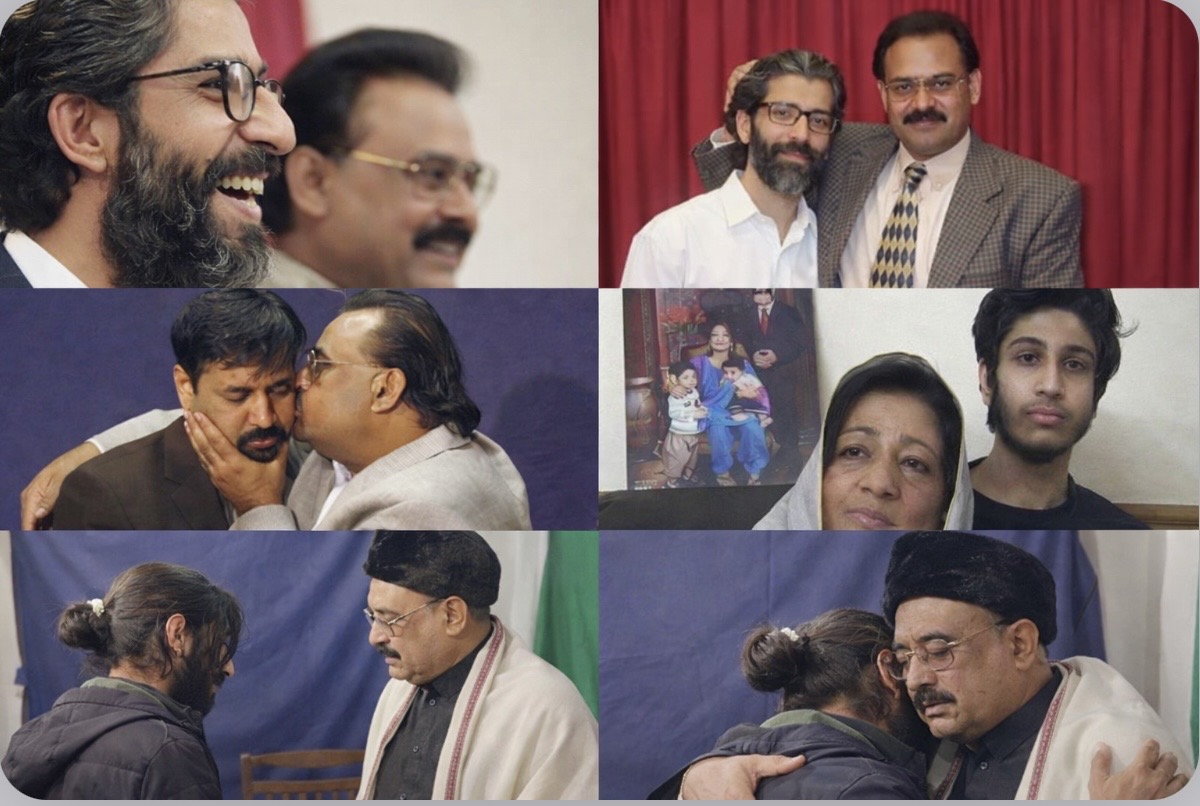
Within this context, the idea of being “from a family” has nothing to do with wealth or poverty. It is tied to sacrifice. Sacrifice is the scale by which character is measured. This brings us to a dimension that cannot be ignored: the conduct of the victim’s family. Their relationship with Altaf Hussain in London, scenes of condolence, and the moment when Imran Farooq’s daughter rested her head on Altaf Hussain’s shoulders and wept are not legal evidence, but they are human indicators. If someone were a murderer, the nature of their relationship with the victim’s family would be entirely different. This does not declare a final verdict, but it raises a question. And a question is always the first step toward thought.
At this point, the discussion moves beyond Mustafa Kamal or Altaf Hussain as individuals. The real issue is engineered politics, periodically imposed on Karachi. Faces change, narratives change, but the cost is always paid by the city and its people.
Whenever there is a hint that an old political actor might regain space, whenever whispers of reconciliation or return are heard, artificial faces become anxious. In fear, the easiest response is to manufacture a new narrative, reopen old wounds, and drag the city back into a psychological war where reason falls behind and anger moves ahead.
It is also a bitter truth that Mustafa Kamal’s politics has always carried a question mark. At times, a rejection of Mohajir identity; at others, an invocation of its pain. At times, slogans of Pakistani nationalism; at others, emotional triggers aimed at specific audiences. This contradiction is not merely political. It is intellectual. A narrative that changes with every season ceases to be an ideology. It becomes a tactic.
I remain firm on one point. Allegations of murder should not be decided on television screens. If Mustafa Kamal truly possesses irrefutable evidence, the path leads through London’s courts, because that is the system the world trusts. If that path is not taken, and only media trials are pursued, then the allegation remains slander by its very nature, no matter how loudly it is repeated.
In the end, we return to where we began. In politics, many things can change, but the moral standard does not. Someone who changes language with circumstances, alters relationships, and attempts to rewrite history may gain temporary advantage, but in history’s court they always stand weak. Their name is remembered alongside figures like Mir Jafar and Mir Sadiq. Karachi has seen much and endured much. Today, the city demands arguments, not abuse. Evidence, not noise. And when the standard of evidence is as rigorous as Scotland Yard’s, many narratives collapse like walls of sand.
That is why no politically conscious person living in Western countries, myself included, accepts Mustafa Kamal’s recent press conference as truth. I hear it as the language of fear. Fear that the difference between real and artificial faces may once again become clear. History shows that when reality emerges, masks fall on their own.
It is difficult not to say that Mustafa Kamal today has little independent political standing. Yet the very toxicity of this press conference is itself a signal. A knock of fear. Fear of what would happen if Altaf Hussain’s outstretched hand toward the establishment were actually taken, if dialogue were to begin. What then would become of the artificial faces, temporary narratives, and rented politics imposed on Karachi for years?
Perhaps it is this fear that drives some to reopen old wounds with new words, to turn slander into narrative, so that the real questions are buried and genuine dialogue never begins. But history bears witness: noise is always the refuge of the weak. Power rooted in truth does not need to shout to make space for itself.
If it has been possible to sit with the Peoples Party and the Muslim League, if yesterday’s fiercest opponents can be accommodated at the state table, then it is not impossible to talk to someone who, despite relentless opposition, remains alive in the hearts of the people.
At this moment, history itself seems to be asking the Field Marshal a question. If hands can be shaken with others, then what hesitation remains in holding the hand extended in reconciliation toward you? If a hybrid system is the country’s compulsion, then include forces that have real public roots, so trust can be rebuilt, the city’s wounds can heal, and artificial faces can be shown the exit from politics. States are not sustained by narratives. They are sustained by trust. And trust is born from accepting the real, not from nurturing the imitation.