

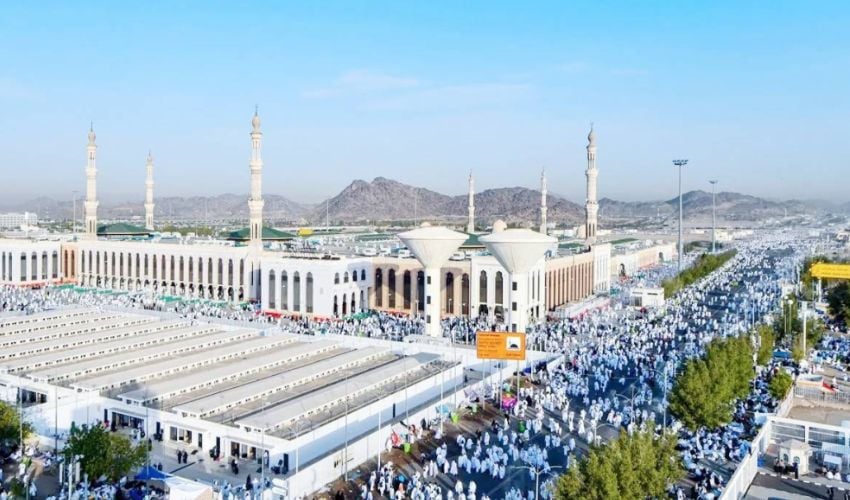
Sheikh Dr. Saleh bin Abdullah bin Humaid, Imam of the Grand Mosque, delivered the 2025 Hajj sermon at Masjid Namirah in the plains of Arafat.
In his comprehensive discourse, he expounded upon the fundamental tenets of Islam, acts of worship, ethical principles, and societal responsibilities. He urged Muslims to embrace piety (taqwa), cultivate patience, express gratitude, and consistently engage in the worship of Allah.
He issued warnings against religious innovations (bid’ah), backbiting (gheebah), and succumbing to satanic temptations.
Sheikh Dr. Humaid underscored the profound importance of the core pillars of Islam, including prayer (salah), fasting (sawm), charity (zakat), and the pilgrimage (Hajj).
The Imam elucidated that prayer serves as the spiritual link between a believer and Allah, and that congregational prayer fosters unity and affection within the community.
Zakat, he explained, functions as a mechanism to support the impoverished and address their necessities.
Sheikh Dr. Saleh bin Abdullah bin Humaid exhorted Muslims to demonstrate kindness towards parents, orphans, the needy, and neighbors. He reminded them to uphold their commitments, speak truthfully, and maintain modesty, asserting these as intrinsic elements of faith. He emphasized the disparity between good and evil, noting that responding to wrongdoings with goodness can transform adversaries into close companions.
The Imam unequivocally declared that worship is due solely to Allah, and no prophet or saint merits worship. He affirmed that Allah sent the Prophet Muhammad (peace be upon him) as a mercy to all humanity, and his advent was foretold in previous divine scriptures. Belief in all prophets, he stressed, constitutes a fundamental aspect of Islamic faith.
He called upon Muslims to adopt taqwa (God-consciousness), to fear Allah, and to turn to Him in earnest supplication, highlighting that Allah is with those who are patient. He articulated that salvation and success in both this life and the Hereafter are contingent upon faith, and that taqwa brings forth blessings in both realms.
Sheikh Dr. Humaid offered a heartfelt supplication (dua): “O Allah, grant our leaders guidance and aid them against their enemies and Yours. Feed their hungry, shelter them from the evil of their foes. O Allah, support our brothers in Palestine. Grant us patience, gratitude, and sincerity in worship.”
He also extended his gratitude to the Saudi government for its diligent efforts in facilitating the pilgrimage and providing care for the pilgrims.
He reiterated to the listeners that Hajj serves as a powerful reminder of the Hereafter.
Sheikh Dr. Humaid emphasized that Allah has perfected the religion on this auspicious day and has chosen Islam as the designated way of life for all humankind.
Annual Hajj Pilgrimage Underway
The annual Hajj pilgrimage has officially commenced, with approximately two million pilgrims having settled into the sprawling tent city of Mina.
Hajj, recognized as one of Islam’s five pillars, annually draws millions of Muslims worldwide. For those with the financial means, it represents a once-in-a-lifetime spiritual journey.
The air in Makkah resonates with the profound chants of Labbaik Allahumma Labbaik, signifying the pilgrims’ initiation of their sacred journey.
A total of 88,301 Pakistani pilgrims are participating through the government scheme, while an additional 27,012 are performing Hajj via private operators. Pilgrims from Pakistan have been transported to Mina by buses from various residential areas, including Aziziyah, Naseem, and Batha Quraish.
After donning the ihram and performing two units of prayer (rakats), the pilgrims made their intention for Hajj and proceeded to Mina. On the morning of the 9th of Dhul-Hijjah, they will advance to the plains of Arafat for the most pivotal rite of Hajj – Wuquf-e-Arafat (Standing at Arafat).
Following the Hajj sermon on the 9th of Dhul-Hijjah, pilgrims will perform combined Zuhr and Asr prayers and remain at Arafat until sunset.
Without performing the Maghrib prayer in Arafat, they will then proceed to Muzdalifah, where they will combine Maghrib and Isha prayers and spend the night under the open sky.
While in Muzdalifah, pilgrims will collect pebbles for the symbolic stoning of the devil. On the morning of the 10th of Dhul-Hijjah, they will proceed for Ramy al-Jamarat (stoning of the large devil) by throwing seven pebbles. This will be followed by sacrificial rituals, after which male pilgrims will shave their heads (halq) and female pilgrims will trim a portion of their hair, signifying the completion of Ihram.
On the 11th of Dhul-Hijjah, pilgrims will stone all three devils—the small, medium, and large—with seven pebbles each. Subsequent to the Ramy, they will proceed to the Holy Kaaba for the Tawaf al-Ziyarah (Farewell Tawaf), followed by the Sa’i ritual performed between Safa and Marwah.
The stoning ritual continues on the 12th of Dhul-Hijjah, post-midday. Pilgrims have the option to return to their accommodations in Makkah on the 12th or extend their stay in Mina to complete the ritual on the 13th of Dhul-Hijjah.
Chanting “Labbaik Allahumma Labbaik” (“Here I am, O God, here I am answering Your call”), over 1.5 million pilgrims from across the globe gathered in Mina on Wednesday, marking the official commencement of Hajj with the Day of Tarwiyah.
Pilgrims began their arrival in the early hours of the day, with Saudi authorities executing a meticulously planned operation to ensure seamless and secure transportation. By Wednesday afternoon, the movement of pilgrims into the expansive tent city of Mina was successfully completed. Over 8,000 buses transported worshippers from Makkah to Mina, fostering an atmosphere imbued with spirituality and devotion.
This year, more than 1.47 million international pilgrims are participating in the annual pilgrimage, joined by hundreds of thousands of domestic pilgrims. Among them are 2,443 pilgrims from 100 countries, who are hosted as guests of the Custodian of the Two Holy Mosques, King Salman.
Upon their arrival in Makkah on Tuesday, pilgrims performed Tawaf Al-Qudum (the Tawaf of Arrival), an essential rite of Hajj, before heading to Mina. The valley resonated with the pilgrims’ recitation of the Talbiyah, cultivating an atmosphere of unity and profound religious commitment.
In adherence to the noble tradition of the Prophet Muhammad (peace be upon him), pilgrims will spend the night in Mina engaged in prayer and reflection, preparing for the pivotal rite of Wuquf (Standing) at Arafat on Thursday—regarded as the most significant pillar of Hajj.
Saudi authorities, in collaboration with Hajj missions worldwide, have mobilized over 40 government agencies and deployed 250,000 personnel to manage the pilgrimage. Advanced technologies, including artificial intelligence and drone technology, are being extensively utilized to monitor crowds and streamline services.
Grand Mufti Sheikh Abdulaziz Al-Sheikh, who chairs the Council of Senior Scholars, received visitors at his Mina residence on Wednesday and designated five scholars to provide religious guidance during Hajj. Sheikh Abdulrahman Al-Sudais, head of Religious Affairs at the Grand Mosque and the Prophet’s Mosque, urged pilgrims to continue reciting the Talbiyah until they begin the stoning ritual at Jamarat Al-Aqaba on the 10th of Dhul Hijjah.
Pilgrims have also been advised to perform prayers at their prescribed times and to follow the specific format of shortening prayers without combining them, with the exception of Maghrib and Fajr, which should be performed in full.
Given the soaring temperatures, the Ministry of Health has issued heat advisories, emphasizing the importance of hydration, sun protection, and minimizing physical exertion during peak sunlight hours (10 a.m. to 4 p.m.). Pilgrims have been observed using white umbrellas to shield themselves from the intense sun, as Saudi Arabia implements enhanced heat-mitigation measures following last year’s severe heat wave.
Hajj, one of the five pillars of Islam, typically spans five to six days and remains one of the largest annual religious gatherings globally.
