

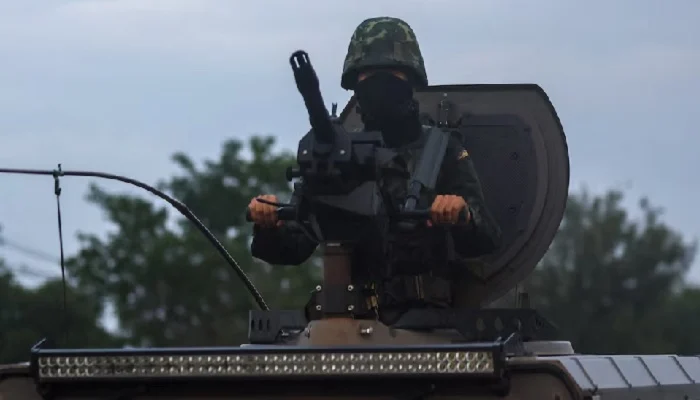
Thailand announced late Saturday its in-principle agreement to a ceasefire with Cambodia and to initiating a “bilateral dialogue” aimed at ending the deadliest conflict between the nations in over a decade. The Southeast Asian neighbors had engaged in heavy artillery fire for a third consecutive day on Saturday, as a border dispute that has claimed at least 33 lives and displaced over 150,000 individuals from their homes intensified across the frontier.
“Thailand agrees in principle to have a ceasefire in place,” the foreign ministry stated in an X post. This announcement followed a post by US President Donald Trump, who indicated he had spoken with Cambodian leader Hun Manet and Thailand’s acting Prime Minister Phumtham Wechayachai, and that both sides had agreed to meet and “quickly work out” a ceasefire. Thailand’s foreign ministry confirmed the phone call between Trump and Phumtham, emphasizing that regarding a potential ceasefire, “Thailand would like to see sincere intention from the Cambodian side.” It further noted that Phumtham had requested Trump to “convey to the Cambodian side that Thailand wants to convene a bilateral dialogue as soon as possible to bring forth measures and procedures for the ceasefire and the eventual peaceful resolution of the conflict.”
Hours prior, clashes erupted in the countries’ coastal regions where they meet on the Gulf of Thailand, approximately 250 kilometers (160 miles) southwest of the primary front lines, with explosions reverberating throughout Saturday afternoon. “It feels like I’m escaping a war zone,” 76-year-old Samlee Sornchai told AFP at a temple shelter for evacuees in the Thai town of Kanthararom, after abandoning his farm near the embattled frontier. A long-running border dispute escalated into combat this week, involving jets, tanks, and ground troops. Tensions initially flared over ancient temple sites that have been contested for decades before the fighting spread along the rural border region, characterized by a ridge of hills surrounded by dense jungle and agricultural land where locals cultivate rubber and rice.
‘Tragic and Unnecessary’ Losses Mount
While both sides have expressed openness to a truce, they have each accused the other of undermining armistice efforts. Cambodia’s defense ministry confirmed 13 fatalities in the fighting since Thursday, including eight civilians and five soldiers, with 71 people wounded. Thai authorities report 13 civilians and seven soldiers have died on their side, bringing the total casualties across both nations higher than in the last major round of fighting between 2008 and 2011.
Both countries reported a coastline clash early Saturday, with Cambodia accusing Thai forces of firing “five heavy artillery shells” into Pursat province, which borders Thailand’s Trat province. The conflict has forced the evacuation of over 138,000 people from Thailand’s border regions and driven more than 35,000 from their homes in Cambodia. Following an urgent United Nations Security Council meeting Friday in New York, Cambodia’s UN ambassador Chhea Keo stated his country desired “an immediate ceasefire” and a peaceful resolution to the dispute. UN chief Antonio Guterres remained deeply concerned about the armed clashes and urged both sides Saturday to “immediately agree to a ceasefire” and engage in talks to find a lasting solution. “The Secretary-General condemns the tragic and unnecessary loss of lives, injuries to civilians and the damage to homes and infrastructure on both sides,” his deputy spokesman, Farhan Haq, said in a statement.
Rush for Dialogue
Both sides have blamed each other for initiating the hostilities. Additionally, Cambodia has accused Thai forces of using cluster munitions, while Thailand has accused Cambodia of targeting civilian infrastructure, including a hospital that was hit by shells. The fighting represents a dramatic escalation in a long-standing dispute between the neighbors — both popular destinations for millions of foreign tourists — over their shared 800-kilometer border, where dozens of kilometers remain contested.
A UN court ruling in 2013 had settled the matter for over a decade, but the current crisis erupted in May when a Cambodian soldier was killed in a border clash. Relations soured dramatically last month when Cambodia’s influential ex-leader Hun Sen released a recording of a call with Thailand’s then-prime minister Paetongtarn Shinawatra focusing on the dispute. The leak triggered a political crisis in Thailand, as Paetongtarn was accused of not adequately defending Thailand’s interests and of criticizing her own army. She was subsequently suspended from office by a court order.
