

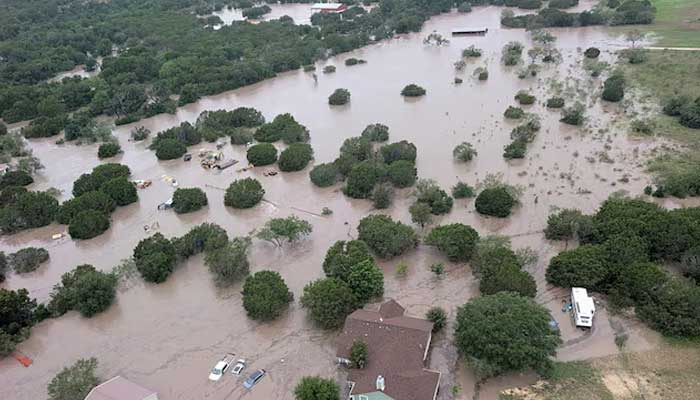
The death toll from the Texas flash floods climbed to 119 on Wednesday, intensifying concerns that the figure could more than double, with over 160 individuals still reported missing.
Workers in central Texas continued their arduous task of sifting through piles of muddy debris left by the July 4 floods. Governor Greg Abbott ordered flags to be lowered to half-staff across the state in remembrance of the tragedy. Officials in Kerr County, the epicenter of the flooding, confirmed on Wednesday that 161 people were known to be missing within the county.
Kerr County, part of a central Texas Hill Country region infamously known as “Flash Flood Alley,” experienced the most severe damage. Sheriff Larry Leitha informed reporters that at least 95 fatalities, including 36 children, occurred in the county. Among the missing were counselors and 27 girls from a summer camp who disappeared early Friday when the Guadalupe River overflowed its banks. As of Wednesday, five campers and one counselor from Camp Mystic were still unaccounted for, along with another child not affiliated with the camp, Leitha stated. An AFP tally of official reports confirmed that two dozen more people have been declared dead elsewhere in the state.
Leitha described the response as an “all hands on deck” operation, with more than 2,000 rescue personnel, police, and experts converging on the flood zone. Ben Baker, with the Texas Game Wardens, noted that search and rescue efforts, which included helicopters, drones, and dogs, were complicated by the extensive water, mud, and debris. “When we´re trying to make these recoveries, these large piles can be very obstructive, and to get in deep into these piles, it’s very hazardous,” Baker explained.
Meanwhile, questions have mounted regarding whether US President Donald Trump’s government funding cuts had compromised warning systems, and concerns were also raised about the overall handling of the rescue operation. During sometimes tense news conferences on Tuesday and Wednesday, officials largely sidestepped direct questions concerning the speed of the emergency response. “There´s going to be an after-action review of what happened,” Sheriff Leitha said, acknowledging that “those questions need to be answered.” However, officials stressed that their immediate priority remained locating the missing and reuniting families.
‘Door-to-Door’ Rescues Amidst the Chaos
Kerrville police officer Jonathan Lamb recounted heroic rescues performed by authorities and volunteers, who successfully evacuated hundreds of people from their homes or vehicles. Lamb told reporters that officers went “door to door, waking people up” in Kerr County early Friday, and in some instances, “pulling them out of windows” of rapidly flooding homes and trailers. He added that the tragedy, “as horrific as it is, could have been so much worse.”
The National Weather Service (NWS) forecast scattered storms for Wednesday in the Hill Country, including isolated pockets of heavy rain. In the neighboring state of New Mexico, flash flooding on Tuesday resulted in three fatalities in Ruidoso, the village website stated, noting that the Ruidoso River swelled to a record-breaking 20 feet (six meters).
Recovering Bodies from the Mud
In the Texas town of Hunt, an AFP team observed recovery workers meticulously sifting through piles of debris, with helicopters circling overhead. Javier Torres, 24, was seen digging through mud as he searched for his grandmother, having already located the body of his grandfather. He also tragically discovered the bodies of two children, apparently washed ashore by the river’s force.
President Trump is scheduled to visit Texas on Friday with First Lady Melania Trump. Commenting on the rescue efforts, Trump stated, “We brought in a lot of helicopters from all over… They were real pros, and they were responsible for pulling out a lot of people.”
Shel Winkley, a weather expert with the Climate Central research group, attributed the extensive nature of the disaster to a combination of geography and an exceptional drought, where parched soil absorbs less rainfall. “This part of Texas, at least in the Kerr County flood specifically, was in an extreme to exceptional drought…. We know that since May, temperatures have been above average,” Winkley informed reporters.
