

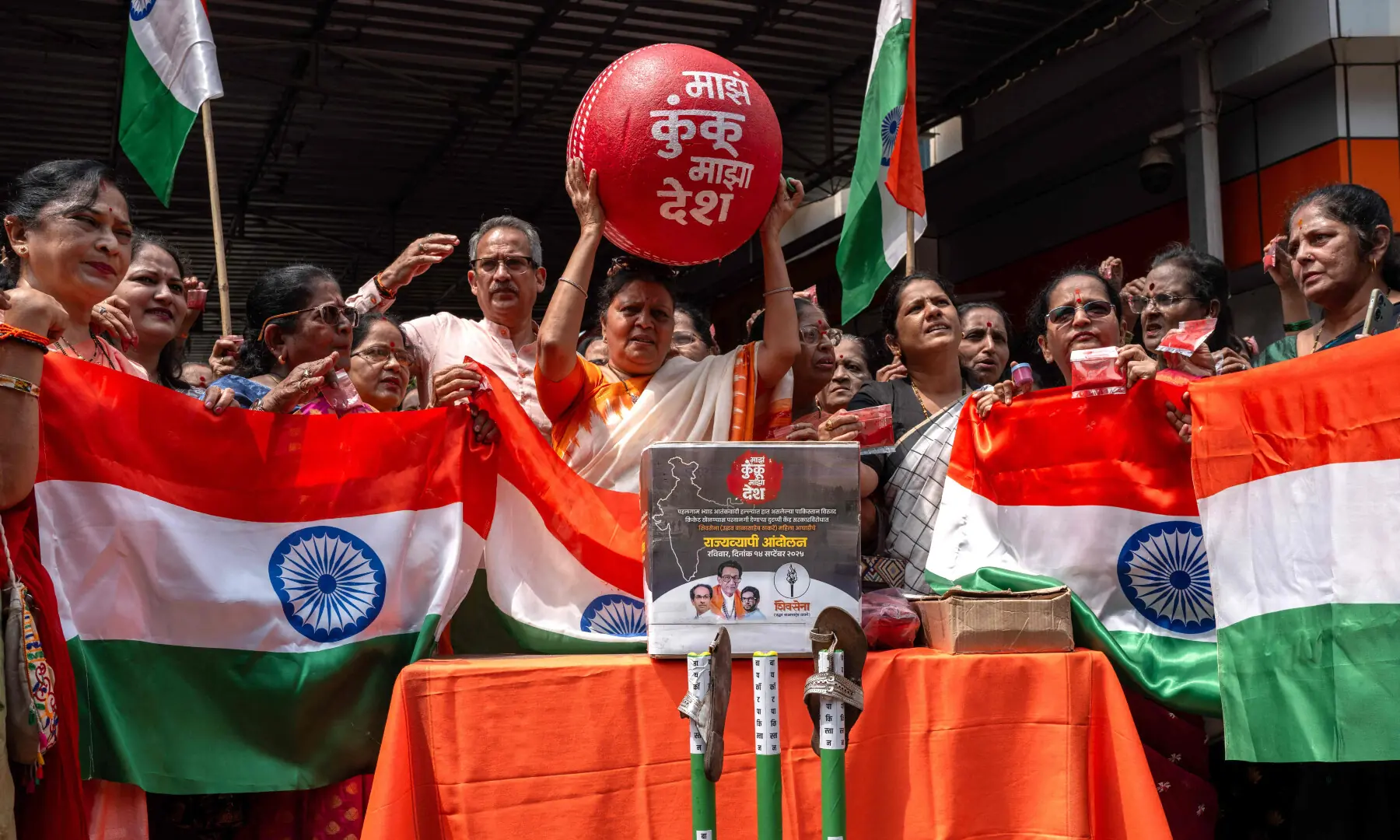
Emotions are running high in India ahead of today’s Asia Cup cricket match against Pakistan, with a recent military conflict and ongoing tensions deepening the usual rivalry. The game, the first between the two teams since a four-day military conflict in May, has sparked a wave of protests and calls for a boycott from Indian politicians and public figures.
Calls for Boycott and Protests
Several prominent voices in India, including former cricketers and politicians, have urged the BCCI (Board of Control for Cricket in India) to boycott the match.
- Uddhav Thackeray, the former chief minister of Maharashtra and head of the Shiv Sena-UBT party, has organized protests across the state. He questioned the government’s decision, citing a previous statement by the prime minister that “blood and water cannot flow together.” Thackeray’s party also symbolically burned a Pakistani national flag in Thiruvananthapuram to protest the match.
- Arvind Kejriwal, national convener of the Aam Aadmi Party (AAP), called the match “treason against the country,” stating that “blood and sports cannot go together.” His party also burned an effigy symbolizing Pakistani players.
- Former Indian cricketer Kedhar Jadhav, a member of the ruling Bharatiya Janata Party (BJP), publicly stated that the match “should not be played.”
- Manoj Tiwary, another former cricketer and politician, announced he was boycotting the entire Asia Cup, questioning the BCCI’s justification for playing the game.
The issue even reached the Indian Supreme Court, which rejected a petition filed by law students to halt the match, arguing it was “against national interest.”
Government and BCCI’s Stance
In contrast to the public backlash, the Indian government and the BCCI have defended the decision to play. The government’s new sports policy allows the national team to compete against Pakistan in multi-national events but not in bilateral competitions.
- BJP lawmaker and former sports minister Anurag Thakur explained that playing in international tournaments like the Asia Cup is a “compulsion” for participating nations. He stated that not playing would lead to India forfeiting the match and being eliminated from the tournament.
- BCCI Secretary Devajit Saikia echoed this, saying a boycott would “bring a lot of negativity” for India’s future plans to host multinational tournaments.
- India’s fielding coach, Ryan ten Doeschate, confirmed that the team has been instructed to follow the directives of the BCCI and the government. He emphasized that the team’s focus is on separating sports and politics and concentrating on the game.
On the Pakistani side, former captain Wasim Akram has urged players from both teams to “ignore the noise” and focus on the game, stating that “one team will win, and one team will lose.”
The match today is the first of what could be up to three potential clashes in the Asia Cup, as both India and Pakistan are strong contenders to reach the Super Four stage and potentially the final on September 28.
