

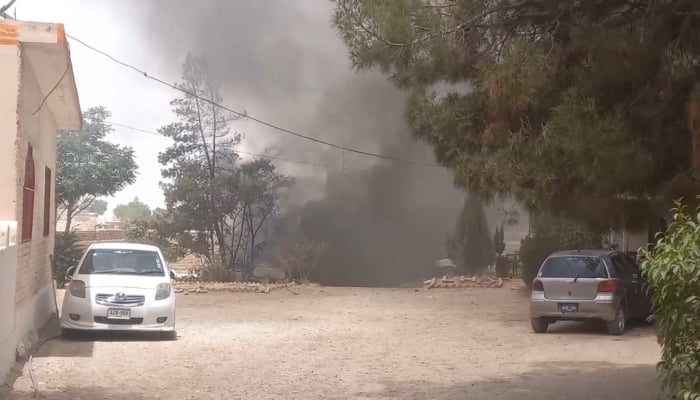
On Tuesday, a teenager was killed in Balochistan’s Mastung district, where security forces also shot dead at least two terrorists, as confirmed by the district administration. The administration reported that seven other individuals sustained injuries during an attack on Levies Line in the district. The assailants also set multiple vehicles ablaze before fleeing the scene after carrying out the deadly attack.
The injured were subsequently transported to Nawab Ghous Bakhsh Raisani Hospital Mastung for medical attention.
Responding to the incident, Balochistan Government Spokesperson Shahid Rind stated that “Indian-sponsored terrorists” attacked a local bank and tehsil offices. Confirming the death of a 16-year-old youth, Rind added that security forces encircled the militants, resulting in the neutralization of two and injuries to three others during the intense exchange of fire. The spokesperson highlighted that “the immediate response of the security forces was effective in preventing an increase in casualties,” further noting that a systematic clearance operation was underway at the attack site, with security agencies actively tracking the facilitators of the attackers.
Pakistan experienced a slight increase in militant attacks in May 2025, even though heightened military tensions with neighboring India did not trigger a significant escalation in violence from extremist groups. Data released by the Islamabad-based Pakistan Institute for Conflict and Security Studies (PICSS) indicates a 5% rise in attacks compared to April, though the overall picture suggests militant groups largely remained contained despite the regional geopolitical climate.
According to the PICSS monthly security assessment, May recorded 85 militant attacks, a marginal increase from 81 in April. These incidents resulted in 113 fatalities, including 52 security forces personnel, 46 civilians, 11 militants, and four members of peace committees. The month also saw 182 individuals injured, comprising 130 civilians, 47 security personnel, four militants, and one peace committee member.
While the overall number of attacks saw only a modest increase, a deeper analysis of the figures reveals some concerning trends. Deaths among security personnel surged by a significant 73%, underscoring the persistent threat faced by Pakistan’s armed forces. Civilian injuries also witnessed a dramatic 145% increase, jumping from 53 in April to 130 in May, highlighting the growing impact of militant activities on the general populace. Conversely, injuries among security personnel decreased by 20%, falling from 59 to 47.
In operations initiated by security forces during the month, at least 59 militants were killed, while five security personnel lost their lives. Combining militant attacks and security operations, the overall casualty toll for May stood at 172, including 57 security personnel, 65 militants, 46 civilians, and four peace committee members.
Balochistan and Khyber Pakhtunkhwa remained the most affected provinces, accounting for 82 of the 85 attacks nationwide. Balochistan experienced the highest level of violence, with 35 militant attacks that resulted in 51 deaths—including 30 civilians, 18 security personnel, and three militants—and 100 injuries (94 civilians, five security personnel, one militant).
