

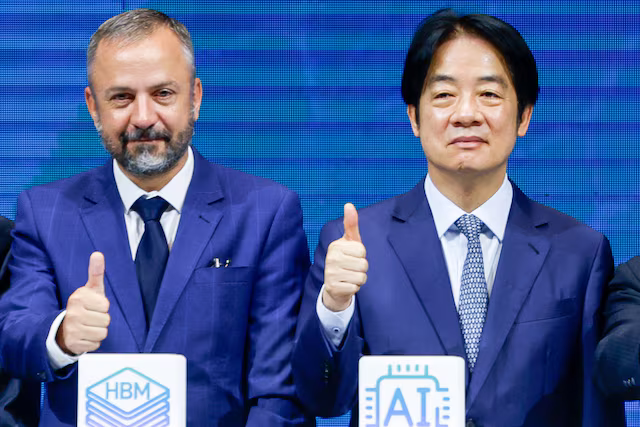
At the Semicon trade show in Taipei this week, a new theme emerged: Taiwan’s strategy of using its leading position in the semiconductor industry to boost its diplomatic standing. As the home of TSMC, the world’s largest contract chipmaker, Taiwan is a global technology powerhouse. However, due to China’s sovereignty claims, it remains diplomatically isolated, with most nations unable to forge formal ties with Taipei.
Speaking at a geopolitics event co-sponsored for the first time by Taiwan’s foreign ministry, Foreign Minister Lin Chia-lung emphasized that semiconductors and AI are “strategic resources.” Lin added, “We firmly believe that only by working with Taiwan can the free world create trusted non-red supply chains,” a reference to efforts to shift global supply chains away from China. Taiwan is particularly eager to strengthen tech ties with “like-minded” democracies, especially those in Central and Eastern Europe, where the Russian invasion of Ukraine has created empathy for the threat Taiwan says it faces from China.
At a separate Semicon event, Czech Minister for Science, Research and Innovation, Marek Zenisek, highlighted the shared values of democracy, freedom, and openness between his country and Taiwan. “These values are under increasing pressure across the board. They are also the reason why our partnership is natural,” said Zenisek, whose country is positioning itself as a key supplier for TSMC’s first European factory being built across the border in Germany.
Beyond its traditional, though informal, supporters in the U.S. and Europe, the Semicon event also attracted some unexpected attendees from countries that have long since switched diplomatic recognition from Taiwan to China. For the first time ever, the show featured 17 country pavilions, including a debut from Costa Rica, the first Central American country to switch diplomatic ties to China in 2007. The Costa Rican delegation declined to comment.
A delegation from Africa also attended for the first time. The continent is a region where China has broad diplomatic and economic influence, while Taiwan has very little. A group of 10 African tech entrepreneurs, whose trip was arranged with help from the de facto French embassy in Taiwan, met with Foreign Minister Lin. Joelle Itoua Owona, CEO of AfriWell Health from the Republic of Congo (which has not had relations with Taiwan since 1964), told Reuters that African governments want to diversify their partnerships. She noted that just as countries like the U.S. and France receive investment from both Taiwan and China, Africa should do the same. “Taiwan is an additional friend” for Africa, she said.
