

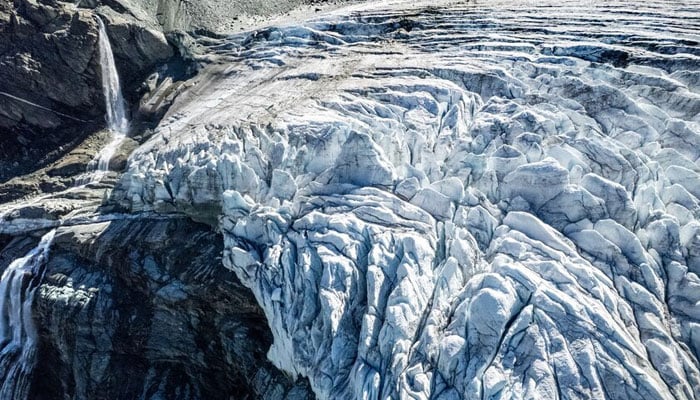
OBERGOMS, SWITZERLAND – Switzerland’s glaciers have melted considerably over the past 12 months, registering the fourth-largest reduction in ice volume on record, according to the monitoring body GLAMOS on Wednesday.
The annual report by GLAMOS and the Swiss Commission for Cryosphere Observation found that a winter marked by minimal snowfall, particularly in the northeastern Swiss Alps, followed by intense heat waves in June, caused the glaciers to lose 3% of their total ice mass.
“This is really a lot,” said Matthias Huss, the director of GLAMOS, whose reports cover the October-September hydrological year.
While the melt rate was not as extreme as the record-setting years of 2022 and 2023 (when glaciers lost 5.9% and 4.4% respectively), the long-term trend is clearly alarming. Huss, speaking to Reuters during a visit to the Rhone Glacier, stated that Switzerland has logged its worst decade of ice melt on record, with one quarter of total glacier volume lost since 2015.
The Rhone Glacier, once the largest in Europe during the Ice Age, rapidly shrunk, losing an average of about 1.5 meters in thickness this year alone. GLAMOS reports that approximately one hundred Swiss glaciers have vanished between 2016 and 2022, and the body warns that most could disappear by the end of the century.
Huss noted the grim outlook, saying, “Unfortunately, there is not much we can do to save the glaciers… They will continue retreating anyway, even if the climate is stabilised today.” However, he offered a sliver of hope: if global carbon dioxide emissions were to fall to zero over the next 30 years, up to 200 high-elevation Swiss glaciers could still be saved.
Glaciers located below 3,000 meters above sea level suffered the most this year. The report highlighted the once healthy Silvretta Glacier in northeastern Switzerland, which experienced a huge melt following the lowest amount of snowfall for the area since measurements began about 100 years ago.
Huss also issued a serious warning that the shrinking of glaciers contributes to the destabilisation of mountains. This increases the risk of rock and ice avalanches, such as the devastating glacier collapse that destroyed the village of Blatten in Valais in May of this year.
