

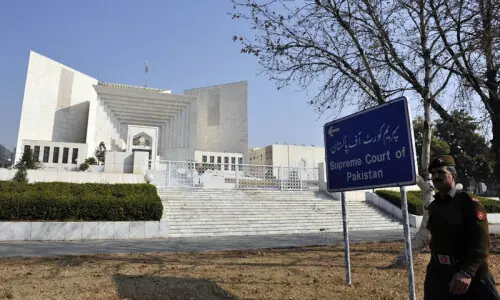
In a 10-page order, Justice Aqeel Ahmed Abbasi of the Supreme Court stated that “any other interpretation of Section 182 of the PPC would result in multiplying criminal litigation arising out of the same proceedings and would open the floodgates for filing frivolous cases in every matter where the complainant could not succeed for reasons such as jurisdictional defects, limitation, insufficient evidence, or benefit of doubt.”
Justice Abbasi, part of a two-judge Supreme Court bench, was hearing an appeal filed by Ali Adnan Sheikha against a May 29 order from a Sindh High Court (SHC) judge. The central issue in the case was to determine who had the authority to initiate legal proceedings under Section 182 of the Pakistan Penal Code (PPC). The judge ruled that a magistrate could only take notice of such a case based on a written complaint from the concerned police officer, clarifying that an ex-officio justice of peace has no authority to order a complaint to be filed under this section. The ruling thus defined the jurisdictional boundaries between magistrates, police officers, and justices of peace.
In his appeal, Mr. Sheikha sought action against respondents Muzzamil Ali Sheikha and Mustansar Ali Sheikha, alleging they had filed a false FIR and given false evidence against him and his late father some 20 years earlier, a matter that had caused prolonged litigation and personal distress.
However, the Supreme Court upheld the rulings of both the SHC and the Sessions Court, which had refused to direct the police to register a case under Section 182 of the PPC. The court made it clear that mere allegations of a false FIR do not automatically justify fresh criminal proceedings.
The SC’s ruling emphasized that under Section 195 of the Criminal Procedure Code, courts are barred from taking notice of offenses under PPC Sections 172-188, including giving false information under Section 182, unless a written complaint is filed by the public servant concerned. This provision was described as a key safeguard against the misuse of the criminal justice system.
While dismissing the appeal, Justice Abbasi also imposed a cost of Rs25,000 on the petitioner. He stated that the SHC judge had correctly addressed all factual and legal issues in line with the law, and that the challenged judgment had no factual or legal flaws.
