

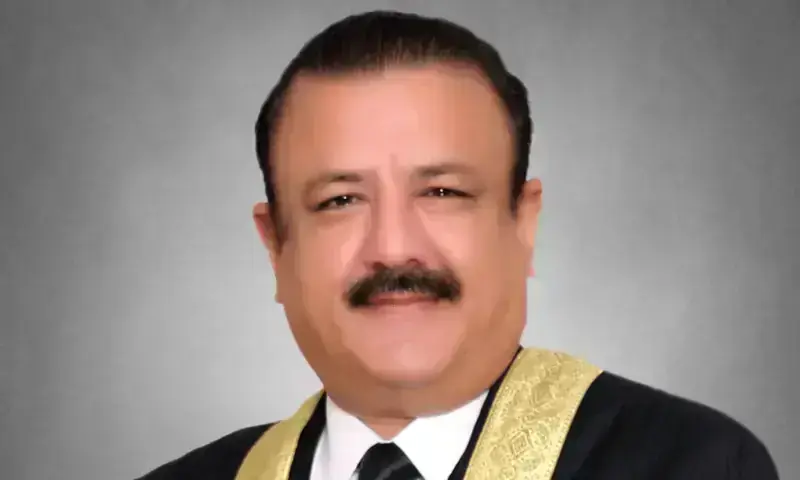
ISLAMABAD, PAKISTAN:
The Supreme Court (SC) of Pakistan on Tuesday delivered a significant ruling, declaring the Islamabad High Court’s (IHC) September 16 decision to restrain Justice Tariq Mehmood Jahangiri from judicial work “null and void.” The ruling came a day after the apex court had already ordered the suspension of the IHC’s interim measure.
The matter centers on a controversy over a letter circulated last year regarding the validity of the judge’s law degree from the University of Karachi.
Resuming the hearing, the five-member Constitutional Bench (CB), led by Justice Aminuddin Khan, took up Justice Jahangiri’s petition challenging the restraining order. Attorney General of Pakistan (AGP) Mansoor Usman Awan appeared before the court and stated unequivocally, “A judge cannot be barred from judicial work through an interim order.”
Significantly, Mian Daud, the respondent who had filed the original petition against the judge, agreed with the AGP’s position, confirming, “an order barring a judge from their duties cannot be defended.”
Acknowledging the consensus among the legal officers and the respondent, Justice Aminuddin Khan set aside the IHC order, firmly ruling that a judge cannot be stopped from carrying out their constitutional judicial duties.
The Constitutional Bench also directed the IHC to “first decide on the objections” raised by the SC registrar’s office regarding the maintainability of the original writ petition filed against Justice Jahangiri.
The question of whether a writ petition against a sitting judge is even permissible was a key point of discussion. Justice Jahangiri’s legal counsel, Munir Malik, asserted that in his opinion, “only the SJC [Supreme Judicial Council] can take action against a judge.” Justice Jamal Khan Mandokhail affirmed this by stating, “We have only maintained that a judge may only be removed by the SJC.”
Justice Muhammad Ali Mazhar clarified the limited scope of the SC’s decision, stressing that the only question before the CB was: “whether a judge can be prevented from working through an interim order.” He emphasized that the court was not addressing the maintainability of the quo warranto writ against the judge itself, leaving that for the relevant High Court to decide.
The Degree Controversy and Related Legal Battles
The controversy began with a circulating letter—purportedly from the University of Karachi—that highlighted alleged irregularities, including dual enrollment numbers, in Justice Jahangiri’s LLB degree. The matter escalated, leading to the filing of a reference with the SJC.
In a separate legal development, the Sindh High Court (SHC) had previously suspended the University of Karachi’s decision to revoke the judge’s degree, noting that the university’s syndicate had acted in Justice Jahangiri’s absence, depriving him of due process.
The Supreme Court’s decisive ruling reinforces the principle of judicial independence and the constitutional safeguard that judges can only be removed or restrained from duty through the specific, high-standard procedure outlined for the Supreme Judicial Council. Justice Jahangiri’s separate petition challenging the cancellation of his law degree remains under review before the Sindh High Court.
