

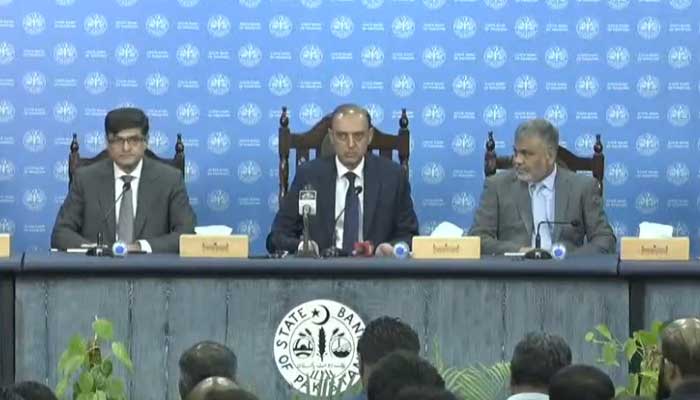
The State Bank of Pakistan (SBP) has decided to maintain its key interest rate at 11%, a move that surprised analysts who had anticipated another cut. This expectation was based on cooling inflation and the perceived need to further boost economic growth. The decision was announced by SBP Governor Jameel Ahmed following a meeting of the Monetary Policy Committee (MPC).
Addressing a press conference in Karachi, the SBP chief stated that while inflation reached its lowest point in April, it saw a slight increase during May and June. This rise was primarily driven by higher energy costs and the base effect. The governor further noted that inflation might moderately increase in the coming months due to continued pressure from energy prices.
On the external front, he reported that Pakistan’s exports have grown by 4%, emphasizing that sustained growth in exports is crucial for maintaining current account stability. The governor also confirmed a significant increase in worker remittances, which rose by $8 billion and contributed to keeping the current account in surplus.
Macroeconomic Stability and Call for Structural Reforms
Highlighting the country’s macroeconomic stability, Jameel Ahmed stated that Pakistan met all its debt obligations on time, and foreign exchange reserves increased by $5 billion even after making $26 billion in external payments. He also mentioned that the agricultural sector is showing signs of recovery, which is expected to support overall economic growth in the current financial year.
According to a statement issued by the central bank, the MPC observed that the inflation outlook has somewhat worsened due to a higher-than-anticipated adjustment in energy prices, particularly gas tariffs. “Nonetheless, inflation is projected to stabilize in the target range going forward,” the statement affirmed, adding that economic activity was gaining further traction amidst the still-unfolding impact of previous policy rate reductions.
The Committee also noted that the trade deficit is expected to widen further in FY22 due to increased economic activity and a slowdown in global trade. “Given this macroeconomic outlook and the emerging risks, the MPC considered today’s decision as necessary to ensure price stability,” the statement concluded.
The committee also highlighted key developments since its last meeting. Firstly, the SBP’s foreign exchange reserves surpassed $14 billion due to improved financial inflows and a current account surplus. Secondly, a recent upgrade in Pakistan’s sovereign credit rating led to a decline in Eurobond yields and narrowed CDS spreads in international markets. Moreover, consumer inflation expectations increased slightly, while business expectations declined in the latest sentiment surveys. Lastly, the statement noted that global oil prices remained volatile, while metal prices increased. “At the same time, the impact of global trade tariffs remained uncertain, prompting central banks to maintain their cautious monetary policy stance,” it added.
“In view of these developments and potential risks, the Committee assessed that the real policy rate should continue to be adequately positive to stabilize inflation in the target range of 5% to 7%.” Furthermore, the committee reiterated its view that without structural reforms, achieving higher growth on a sustainable basis would be challenging.
This decision comes as the government pushes reforms under a $7 billion IMF program and a contractionary budget aimed at curbing deficits. In its Economic Outlook Update on Tuesday, the IMF lowered its growth forecast for the fiscal year ending June 2026 to 3.6%, which is notably below the government’s 4.2% target.
The SBP had previously held rates in June after a 100-basis-point cut in May, which resumed easing following a pause in March. Since June 2024, the SBP has lowered its policy rate by 1,100 basis points from a record 22% as price pressures receded. In a Reuters poll this week, all 15 analysts had expected the SBP to ease, with nine forecasting a 50-basis-point cut, four predicting a deeper 100-basis-point reduction, and two projecting a smaller 25-basis-point cut. Headline inflation slowed to 3.2% in June and is projected at 3.5%–4.5% in July, remaining within the SBP’s 5.5%–7.5% target range for the fiscal year ending June 2026. While the government asserts that the economy has stabilized, analysts caution that growth remains fragile and swings in global commodity prices could still exert pressure on domestic prices and external balances.
