

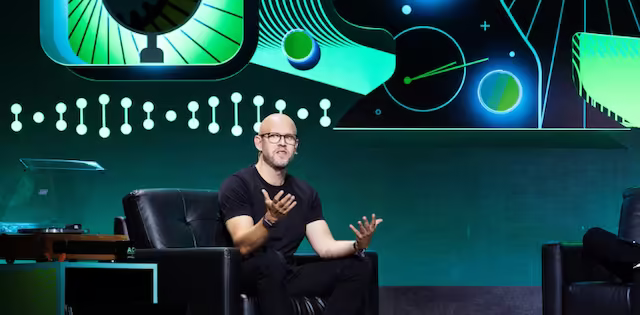
STOCKHOLM, SWEDEN—Spotify, the Swedish music streaming giant, announced a significant leadership restructuring on Tuesday, revealing that founder and CEO Daniel Ek will step down in January to assume the role of Executive Chairman. The company has appointed two long-time executives, Gustav Soderstrom and Alex Norstrom, as Co-CEOs.
This transition comes as Spotify aggressively expands its offerings into podcasts and audiobooks, navigating a delicate strategic balance between maintaining aggressive growth and achieving sustainable profitability. The news caused the company’s shares to slip about 2.5% in premarket trading, following an impressive 63% gain earlier this year.
As Executive Chairman—a role the company describes as a “European-style chairman”—Ek will primarily focus on capital allocation and long-term strategy. As one of Europe’s most prominent tech entrepreneurs, having built Spotify into a rare global consumer technology leader from the region, Ek emphasized that he will continue to steer the company’s strategic direction. “I will be more involved than a typical US chairman,” said Ek, who has served on the board since 2008. “So think of it a little bit like moving from a player to a coach.”
Spotify remains the clear market leader with nearly 700 million monthly users and over 100 million tracks, significantly ahead of competitors like Apple Music, which has approximately 90 million subscribers. However, the platform faces fierce competition. YouTube Music leverages a vast video-integrated catalogue, and Amazon Music benefits from its offerings being linked to Prime subscriptions, giving rivals distinct advantages in certain markets.
Despite Spotify’s market dominance, pressure on profit margins persists. This is driven by ongoing demands from artists for higher payout rates and the necessary expansion of the ad-supported tier. “Naturally, there will be some disruption given the change and the significant achievements under Ek’s stewardship, which have been remarkable,” noted PP Foresight analyst Paolo Pescatore.
The wider context of the music industry shows a robust landscape for streaming. According to IFPI’s Global Music Report, global revenue from recorded music rose 4.8% to $29.6 billion in 2024. Crucially, streaming revenue exceeded $20 billion for the first time, with subscription streaming accounting for more than half of that figure.
The company’s history highlights its transformative impact: Founded in 2006, the Stockholm-based firm played a central role in revitalizing a music industry ravaged by piracy and falling CD sales, reporting its first annual profit only in 2024 following cost-cutting and price increases.
The new Co-CEOs bring deep, interconnected experience. Soderstrom, currently Chief Product and Technology Officer, oversees global tech strategy and product development, while Norstrom, the Chief Business Officer, manages the subscriber and advertising businesses, along with music, podcast, and audiobook operations. They will report to Ek, and the three executives have worked together for a decade and a half.
The move toward a Co-CEO model is not unprecedented, having been adopted by other high-profile, complex, and globally diversified firms like Oracle and Netflix as a way to better manage sprawling operations and share the immense leadership burden.
