

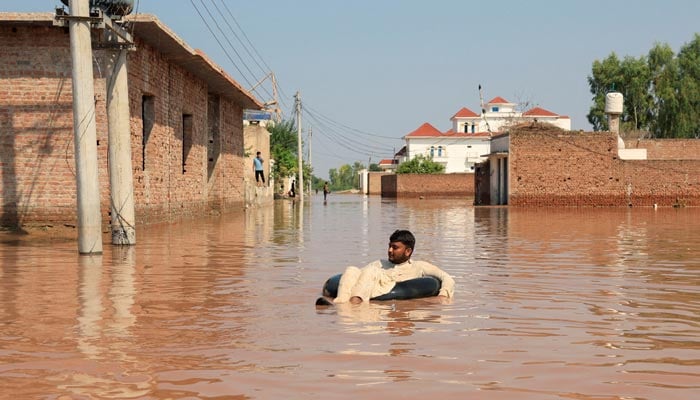
Sindh’s Irrigation Minister, Jam Khan Shoro, has stated that the province is getting ready for a potential super flood as key rivers in the region continue to rise, posing a significant risk to low-lying areas. Speaking on a Friday morning show, the provincial minister noted that the current situation in the Chenab River is one not seen in over a decade. “This kind of flood-like situation in Chenab has occurred after 10 to 12 years,” he said, adding that 1.1 million cusecs of water are moving towards the Trimmu Barrage.
The minister said that officials are closely monitoring the flow of all major rivers, including the Chenab, Ravi, and Sutlej. “We are carefully tracking the river flow and getting ready for all possible scenarios.” Shoro emphasized that breaching embankments [bunds] is not a consideration. “We do not see breaching as a viable option,” he said, adding that emergency measures are being implemented across all vulnerable areas. Shoro also mentioned that provincial ministers have been deployed to oversee embankments, and local commissioners and deputy commissioners have already pinpointed locations for relief camps. “If the embankments fail, water will enter populated areas,” he warned, stressing the need for readiness at every level.
He also raised concerns about infrastructure, mentioning that the Sukkur Barrage’s structure is decades old, and efforts are ongoing to upgrade its gates. “We are replacing the gates at Sukkur Barrage, and more will be replaced next year.” In the meantime, the Sindh Agriculture Department has canceled all staff leaves due to the flood threat. The provincial government has also set up a rain emergency cell at the Director General of Agriculture’s office in Hyderabad. Directors and deputy directors have been appointed as focal persons in 30 districts, including Karachi, Larkana, Sukkur, Hyderabad, and Mirpurkhas.
Additionally, Karachi Mayor Murtaza Wahab said that the overall situation in Sindh is under control as the provincial government and city administration implement precautionary measures ahead of anticipated rainfall and floods. Speaking to the media on Friday, Wahab stated that the Sindh government has taken all necessary steps and the chief minister has issued directives to all departments involved in emergency response. “All government machinery is active and on alert. Ministers and members of the assembly have been assigned duties across Sindh,” Wahab added. He said that the Karachi Metropolitan Corporation (KMC) has completed preparations for the upcoming rainfall, including clearing clogged drainage points in the city’s key areas. “Municipal services will be fully active during rainfall, and city wardens will also play their part,” he said, adding that traffic police and wardens will remain on roads to help with movement and safety.
While urging Karachi residents to stay safe during the expected rain and flood-like situation, the mayor said: “If it rains, please do not panic.” He added: “When we all rush out of offices at once, it causes road congestion and hinders rescue operations.” The National Disaster Management Authority (NDMA) has issued a rain alert for several parts of the country, warning that Karachi may face possible urban flooding between August 30 and September 2. According to the meteorological department, thunderstorms with rain are expected in Islamabad from August 29 to September 2, while heavy rainfall is likely in the northern and north-eastern districts of Punjab on August 30 and 31. The NDMA further said that Karachi, Thatta, Sujawal, Badin, and Tharparkar are expected to receive rainfall from August 30 to September 2. Hyderabad, Dadu, Sukkur, Ghotki, Larkana, Jacobabad, and Kashmore may experience downpours between August 30 and September 1.
