

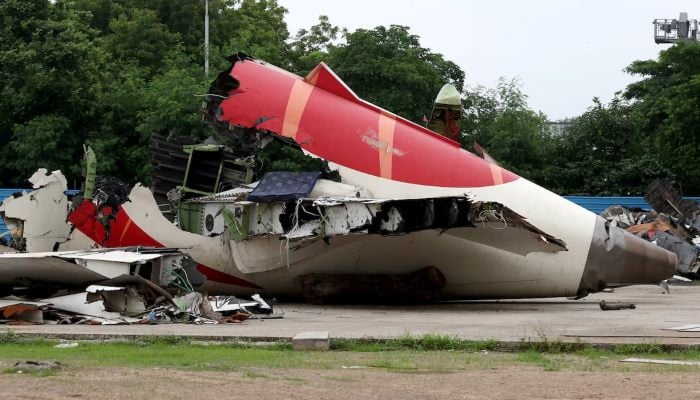
A cockpit recording from the Air India flight that tragically crashed last month indicates the captain deliberately cut the flow of fuel to the aircraft’s engines, as reported by the Wall Street Journal on Wednesday. The newspaper cited individuals familiar with early assessments by U.S. officials, who are examining evidence from the ongoing investigation into the June 12 crash in Ahmedabad, India, which claimed 260 lives.
According to the report, the first officer, who was piloting the Boeing 787 Dreamliner, questioned the more experienced captain about why he moved the fuel switches to the “cutoff” position mere seconds after liftoff from the runway. The pilots involved in the incident were Captain Sumeet Sabharwal and First Officer Clive Kunder, possessing total flying experiences of 15,638 hours and 3,403 hours, respectively.
Reuters’ requests for comment on the Wall Street Journal report to India’s AAIB (Aircraft Accident Investigation Bureau), Directorate General of Civil Aviation, Ministry of Civil Aviation, Air India, and two unions representing Indian pilots went unanswered. Boeing also declined to comment.
A preliminary report on the crash, released by India’s Aircraft Accident Investigation Bureau (AAIB) on Saturday, confirmed that the fuel switches had indeed transitioned from “run” to “cutoff” a second apart, just after takeoff. However, the report did not specify how these switches were moved. Almost immediately after the aircraft left the ground, closed-circuit TV footage revealed the deployment of a backup energy source known as a ram air turbine, signaling a loss of power from the engines. Subsequently, one pilot was heard on the cockpit voice recorder asking the other why the fuel was cut off. The report stated that “the other pilot responded that he did not do so.”
With the fuel supply to the engines severed, the London-bound plane began to lose thrust. After ascending to a height of 650 feet, the aircraft started its descent. The report detailed that the fuel switches for both engines were then returned to the “run” position, and the airplane automatically attempted to restart the engines. However, aviation safety expert John Nance told Reuters that the plane was too low and too slow to be able to recover. The report concluded that the aircraft clipped some trees and a chimney before crashing in a fireball into a building on a nearby medical college campus, resulting in 19 fatalities on the ground and 241 of the 242 occupants onboard the 787.
No Safety Recommendations Issued
In an internal memo circulated on Monday, Air India CEO Campbell Wilson stated that the preliminary report found no mechanical or maintenance faults with the aircraft and confirmed that all required maintenance had been completed. The AAIB’s preliminary report did not include any safety recommendations for Boeing or the engine manufacturer, GE.
Following the report’s release, the U.S. Federal Aviation Administration and Boeing privately issued notifications affirming the safety of fuel switch locks on Boeing planes, a document seen by Reuters and confirmed by four sources knowledgeable on the matter. John Nance, an aviation safety expert, suggested that the circumstantial evidence increasingly points to a crew member having manipulated the engine fuel switches, given there was “no other rational explanation” consistent with the information released to date. Nonetheless, Nance emphasized that investigators “still have to dig into all the factors” and rule out other potential contributing factors, a process that will take time.
Most air crashes are attributed to multiple factors, and under international regulations, a final report is typically expected within a year of an accident. The Air India crash has reignited discussions about the implementation of flight deck cameras, also known as cockpit image recorders, on airliners. Nance suggested that investigators would likely have benefited significantly from having video footage of the cockpit during the Air India flight.
Beyond the crash investigation, Air India has faced additional scrutiny on other fronts. The European Union Aviation Safety Agency recently announced its intention to investigate Air India’s budget airline, Air India Express, following a Reuters report that the carrier allegedly failed to comply with a directive to change engine parts of an Airbus A320 in a timely manner and falsified records to demonstrate compliance.
