

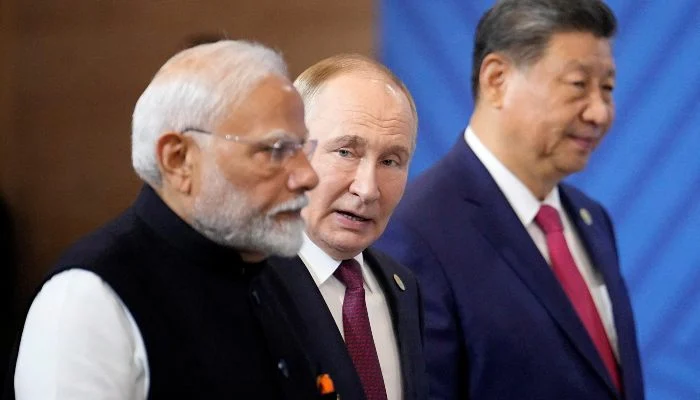
President Xi Jinping will host over 20 world leaders at a regional security forum in China next week, a powerful display of Global South solidarity in the age of Donald Trump, and a diplomatic boost for sanctions-hit Russia.
The Shanghai Cooperation Organisation (SCO) summit, to be held in Tianjin from August 31 to September 1, will be attended by Russian President Vladimir Putin and leaders from Central Asia, the Middle East, South Asia, and Southeast Asia.
A highlight of the summit will be Indian Prime Minister Narendra Modi’s first visit to China in over seven years, as the two nations work to further ease tensions from deadly border clashes in 2020. Modi last shared a stage with Xi and Putin at last year’s BRICS summit in Kazan, Russia, while Western leaders were shunning the Russian leader over the war in Ukraine. Russian embassy officials in New Delhi recently expressed hope for trilateral talks with China and India soon.
According to Eric Olander, editor-in-chief of The China-Global South Project, Xi aims to use the summit to showcase what a “post-American-led international order” could look like. He believes the meeting will demonstrate that the White House’s recent efforts to counter China, Iran, Russia, and India have not had their intended effect. “Just look at how much BRICS has rattled (US President) Donald Trump, which is precisely what these groups are designed to do,” he added.
A Chinese foreign ministry official noted that this year’s summit will be the largest since the SCO was founded in 2001, calling the bloc an “important force in building a new type of international relations.” The security-focused bloc has expanded from six Eurasian nations to 10 permanent members and 16 dialogue and observer countries, with its scope broadening from counter-terrorism to economic and military cooperation.
“Fuzzy” Implementation
Analysts say expansion is a key agenda item for many attendees. However, they agree that the bloc has not delivered significant cooperative outcomes over the years, and that China values the optics of Global South unity against the United States during a period of erratic U.S. policymaking and geopolitical flux.
Manoj Kewalramani, a chairperson at the Takshashila Institution, a Bangalore-based think tank, commented, “What is the precise vision that the SCO represents and its practical implementation are rather fuzzy. It is a platform that has increasing convening power, which helps in narrative projection.” He added that the SCO’s effectiveness in addressing significant security issues remains “very limited.”
Tensions persist between key members Pakistan and India. A June SCO defence ministers’ meeting failed to produce a joint statement after India objected to the omission of a reference to a deadly April 22 attack on Hindu tourists in Indian Illegally Occupied Jammu and Kashmir (IIOJK), which led to the worst fighting between Pakistan and India in decades. New Delhi also refused to join the SCO’s condemnation of Israeli attacks on Iran, a member state, earlier in June.
However, the recent détente between India and China, along with renewed tariff pressure from the Trump administration on New Delhi, has raised expectations for a positive meeting between Xi and Modi on the sidelines of the summit. Olander suggested that New Delhi will likely “swallow their pride and put this year’s SCO problems behind them in a bid to maintain momentum in the détente with China, which is a key Modi priority right now.”
Analysts expect both leaders to announce further incremental border measures, such as troop withdrawals, relaxed trade and visa restrictions, cooperation in new fields like climate, and broader government and people-to-people engagement. Despite the lack of substantive policy announcements expected at the summit, experts caution that the bloc’s appeal to Global South countries should not be underestimated. “This summit is about optics, really powerful optics,” Olander added.
After the summit, Modi is expected to depart from China, while Putin will stay on for a World War Two military parade in Beijing later in the week, an unusually long stay outside of Russia.
