

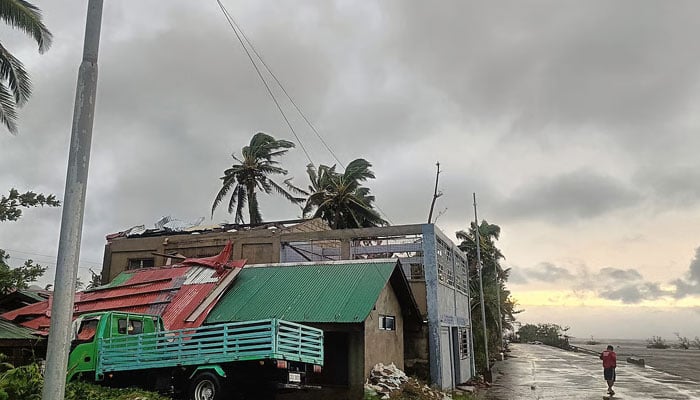
The Philippines confirmed at least three fatalities and evacuated approximately 400,000 people on Friday as Severe Tropical Storm Bualoi battered the country, which is still reeling from the effects of Super Typhoon Ragasa.
Civil defence officials in southern Luzon’s Bicol region reported three deaths caused by collapsing walls and uprooted trees from Bualoi, which is sweeping west-northwest at sustained speeds of 110 kilometers per hour.
The ferocity of the storm was evident when the roof of a church being used as a shelter was ripped away, forcing evacuees to take cover under pews. Jerome Martinez, a municipal engineer in southern Luzon’s Masbate province, described the winds as among the strongest he had ever experienced, noting that children suffered minor injuries. Bernardo Alejandro, a civil defence official, confirmed the massive scale of the evacuation.
Frandell Anthony Abellera, a rescuer in Masbate City, told AFP that workers were struggling to clear “many big trees and toppled electric posts” that made roads impassable, emphasizing, “The rain was strong, but the wind was stronger.” Videos showed widespread flooding in the central Philippines’ Visayas islands, with residents navigating waist-deep water.
Climate Change and Political Anger
The Philippines is consistently battered by an average of 20 storms and typhoons each year, perpetuating poverty in disaster-prone areas. Scientists warn that these storms are intensifying as global warming, driven by human activity, continues. Authorities had warned of a “high risk of life-threatening storm surge” of up to three meters (10 feet) from Bualoi.
The current storms coincide with surging public anger over a scandal involving bogus flood-control projects that allegedly cost taxpayers billions of dollars. Thousands also remain displaced following Super Typhoon Ragasa, which killed at least nine people earlier in the week in the country’s far north.
Taiwan Rescue Efforts Focus on Ragasa Aftermath
Meanwhile, in Taiwan, rescue workers waded through thick mud on Friday, searching for 11 people still missing after Super Typhoon Ragasa triggered a devastating wall of water and mud that swept into the eastern town of Guangfu this week. The flooding death toll remained at 14.
The flood was caused by the overflow of a “barrier lake” in the mountains of Hualien county. Rescue workers were forced to cut holes into the roofs of buildings to check for missing people, as the dark grey mud blanketed large parts of the area. One man, Hwang, shared the tragic loss of his elder sister, who died inside her house which was completely filled with mud.
Many fatalities occurred on the first floors of houses where often elderly residents were unable to follow government orders to move upstairs. Huang Ju-hsing, 88, remains trapped inside his second-floor home after the flooding blocked access to his family’s grocery store downstairs.
The status of the barrier lake, which has shrunk significantly but remains an unresolved issue, continues to pose a threat. The government has ruled out using explosives to breach the bank holding back the water, fearing it could trigger further landslides. Importantly, the disaster has not impacted Taiwan’s crucial semiconductor industry, which is located on the island’s west coast.
