

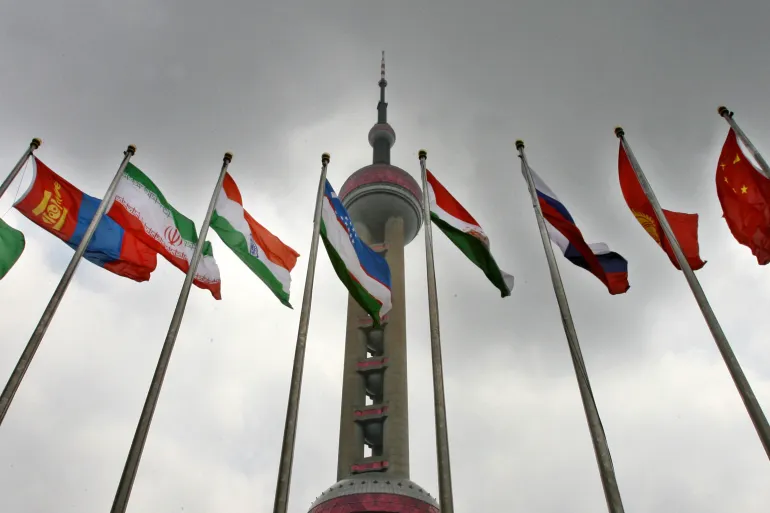
A year later, the geopolitical landscape looks very different. As China prepares to host the annual SCO summit, it expects a fuller house of leaders from the region and beyond. India’s Prime Minister Modi is visiting China for the first time since 2018, a visit that follows a rapprochement between the two nations. This has been further propelled by US President Donald Trump’s 50 percent tariffs on Indian goods, forcing New Delhi to seek stronger partnerships with Beijing and other players in Eurasia.
At a time when much of the world is grappling with the chaos unleashed by Trump’s tariffs and threats, analysts expect the SCO conclave to serve as a platform for Chinese President Xi Jinping to project his country as a stabilizing force. China’s Assistant Foreign Minister Liu Bin said the summit would be “one of China’s most important head-of-state and home-court diplomatic events this year.”
Location and Attendees
This year’s summit took place from August 31 to September 1 in Tianjin, a northern Chinese city. Liu told reporters that the summit would gather more than 20 foreign leaders and the heads of 10 international organizations.
Attendees include leaders of SCO member states: India’s Modi, Russian President Vladimir Putin, Iranian President Masoud Pezeshkian, Pakistani Prime Minister Shehbaz Sharif, Belarusian President Alexander Lukashenko, Kazakhstan’s President Kassym-Jomart Tokayev, Uzbekistan’s President Shavkat Mirziyoyev, Krygyz President Sadyr Japarov, and Tajik President Emomali Rahmon.
Other leaders expected to attend include Turkiye’s President Recep Tayyip Erdogan, Myanmar’s military chief Min Aung Hlaing, Nepal’s Prime Minister K P Sharma Oli, Indonesia’s President Prabowo Subianto, Malaysia’s Prime Minister Anwar Ibrahim, and the Maldives’ President Mohamed Muizzu. United Nations Secretary-General Antonio Guterres and ASEAN Secretary-General Kao Kim Hourn will also be present.
The Significance of the SCO
The SCO began in 1996 as a security bloc called the “Shanghai Five,” formed by China, Russia, Kazakhstan, Kyrgyzstan, and Tajikistan to settle border disputes. In 2001, it evolved into the SCO, including Uzbekistan. In 2017, India and Pakistan joined, followed by Iran in 2023 and Belarus in 2024. The organization also has 14 dialogue partners, including Saudi Arabia and Egypt.
SCO member states account for 43 percent of the world’s population and 23 percent of the global economy. However, Alejandro Reyes, a professor at the University of Hong Kong, told Al Jazeera that the group’s vision and identity remain unclear.
The Relevance of This Summit
This year’s summit takes place amid Russia’s ongoing war in Ukraine, Israel’s actions in Gaza and the West Bank, and Trump’s global trade war. Manoj Kewalramani, a chairperson at the Takshashila Institution in India, said the world is “clearly in deep flux” and that China and Russia will likely use the summit to project a multipolar world order based on the concept of “indivisible security,” a vision that stands in contrast to NATO’s.
Kewalramani also noted that the summit is significant because many believe that multilateralism is facing existential threats due to US policies, and SCO countries “still stand for multilateralism.” Reyes added that the summit’s symbolism is also important, as it allows China to position itself as a world power that has productive relations with many countries.
