

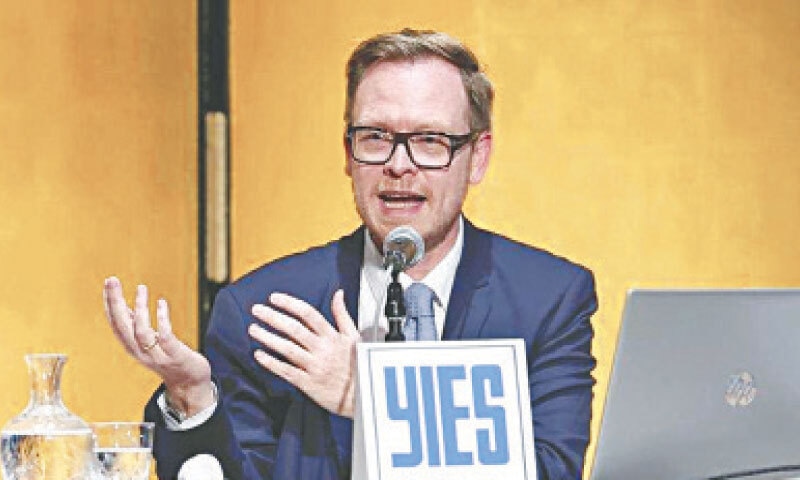
TOKYO, JAPAN – The global trajectory of political and economic systems is shifting toward new forms of governance, according to Professor Gabriel of the University of Bonn, Germany. In a lecture organized by the Yomiuri International Economic Society, Gabriel cautioned that “Authoritarian capitalism is coming, but it’s not there yet.”
Professor Gabriel defined two distinct forms of this emerging system:
- Demagogic: This form presents an internal threat to liberal democracies, particularly if they fall under the influence of a charismatic but manipulative demagogic figure.
- Bureaucratic: This is sometimes used to describe China’s system, though Gabriel disagreed with the label, arguing that China is not fundamentally a capitalist country.
Analysing Neo-Illiberalism and Global ‘Nested Crises’
Gabriel also analyzed the rise of “neo-illiberalism,” defining it by three core features: labour suppression, ethno-nationalism, and clientelism. He noted that under such a system, the destruction or suppression of labour rights is inevitable. He stressed that a rigorous approach to studying non-liberal democracies requires “good political science.”
The world, he asserted, faces “nested crises,” a term he used to describe how multiple concurrent crises “hang together in a spiral… [and] form a typhoon.” He warned against the pervasive influence of technology on analysis, stating, “If you start from AI… everything will look like an AI problem for you.”
Redefining Adam Smith’s ‘Invisible Hand’
Challenging one of the foundational tenets of modern economics, Gabriel revisited 18th-century economist Adam Smith’s metaphor of the “invisible hand.” This metaphor suggests that individuals pursuing their self-interest unintentionally generate beneficial social and economic outcomes.
Gabriel rejected the conventional economic interpretation: “I think that what Adam Smith called the ‘invisible hand’ is not a mathematical law of markets. That was just a mistake.” Instead, he recast the invisible hand as an example of “sympathy” and a prerequisite for ethical capitalism.
Advocating for ethical capitalism—where ethics are an essential part of economic activities—Gabriel highlighted the choice between prioritizing renewable energy versus fossil fuels. He concluded by stressing the importance of learning to “lead not just in markets but in values.”
