

This position was asserted in a joint statement released after foreign ministers from Russia, China, Iran, and Pakistan met on the sidelines of the 80th United Nations General Assembly in New York. They emphasised respect for Afghanistan’s sovereignty, independence, and territorial integrity and declared that the re-establishment of foreign military bases is “not conducive to regional peace and security.”
According to Hamdullah Fitrat, deputy spokesperson for the Taliban government, his country not only welcomed the stance of the four nations but stated that “Afghanistan will not allow its territory to be used against other countries, nor permit armed groups to operate from its soil.”
While the joint statement did not name any specific country seeking bases in Afghanistan, it followed a statement by US President Donald Trump where he had publicly said Washington was attempting to get Bagram air base in Afghanistan back.
Bagram Air Base served as the linchpin for US operations in the country, fighting the long war against the Taliban and Al Qaeda with airstrikes and resupply missions launched from the airfield. In July 2021, all US and Nato troops departed from Afghanistan’s largest air base, marking the complete withdrawal of foreign forces after two decades of conflict. Following his initial comment on Bagram in the UK, Trump had threatened Afghanistan with unspecified consequences if it refused to return control of the air base to the US.
In response, the Taliban government in Afghanistan rejected his demand.
‘Seeking Positive Relations with All’
In their joint statement, the four countries also urgently called on the Taliban rulers to take “effective, concrete and verifiable actions in fulfilling the international obligations and commitments made by Afghanistan to fight terrorism, and dismantle, and eliminate all terrorist groups, and to prevent recruitment, fundraising and their access to weapons, as well as their collaboration with foreign terrorist fighters.”
The four nations further pressed the Afghan authorities to dismantle any terrorist training camps or other terrorist infrastructure on their territory.
Moreover, their joint statement expressed “deep concern over the security situation related to terrorism in Afghanistan,” noting that terrorist groups such as ISIL, Al Qaeda, the Eastern Turkestan Islamic Movement (ETIM), Tehreek-i-Taliban Pakistan (TTP), Jaish ul Adl, Balochistan Liberation Army (BLA) and other similar groups in the region, including the Majeed Brigade, based in Afghanistan, “continue to pose a serious threat to regional and global security.”
“They emphasised that strengthening peace and stability in Afghanistan and countering the threats of terrorism, radicalism, and drug crime emanating from its territory are in line with their common interests in the region.”
In response, Fitrat dismissed the idea of “Afghanistan posing any threat to other countries [as] baseless.”
“Afghanistan is taking serious steps against corruption, drugs and all kinds of undesirable issues and considers this process its responsibility,” he said, stressing that the “Islamic Emirate of Afghanistan wants to establish positive relations with all countries on the basis of mutual respect.”
Fitrat described the “prioritising relations with regional and international countries in the context of security, stability and development in Afghanistan” as a “realistic” approach.
The Afghan government deputy spokesperson asserted that Kabul’s policy is “based on mutual trust, positive contacts and promotion of friendly relations and any false concerns or baseless allegations regarding Afghanistan are strongly rejected.”
Jamaat-e-Islami Delegation Meets Afghan Foreign Minister
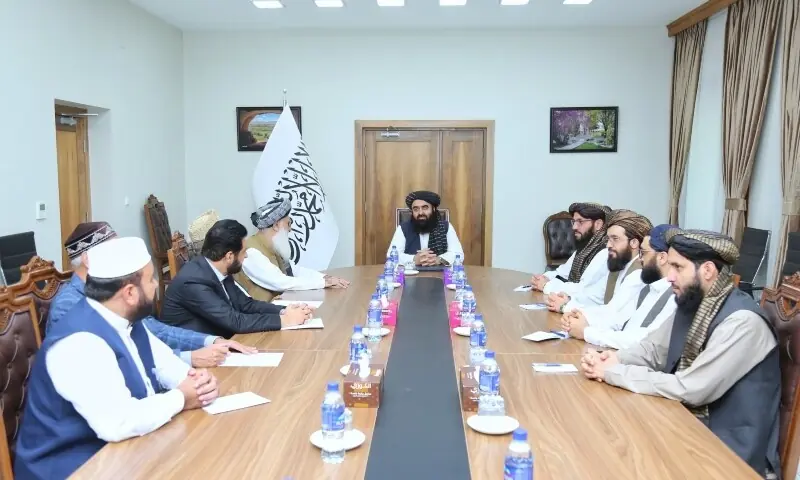
Separately, a delegation from Jamaat-e-Islami (JI) from Pakistan, led by JI Deputy Ameer Professor Muhammad Ibrahim, met with Afghan Foreign Minister Amir Khan Muttaqi during a visit to Afghanistan, according to a party statement.
The delegation included JI Deputy Ameer in Balochistan Dr Atta-ur-Rehman, JI Ameer in Khyber Pakhtunkhwa North Inayatullah Khan, JI Ameer in KP Central Abdul Wasi, and Dr Muhammad Iqbal Khalil.
Muttaqi also posted about the meeting on X. According to a translation of his post, Pakistan-Afghanistan relations were discussed during the conversation.
