

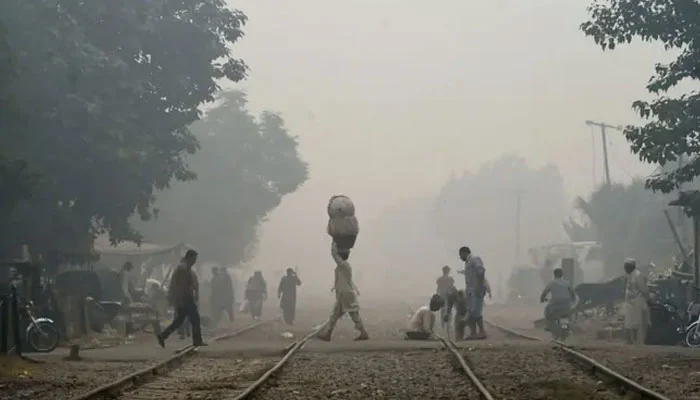
Millions of citizens across Pakistan’s populous heartland, Punjab, are once again facing a severe public health challenge as toxic smog blankets the region. Residents in major cities, including Lahore, Faisalabad, and Multan, woke up on Friday morning to a thick haze that has pushed air quality to extremely dangerous levels.
The data released paints an alarming picture. The industrial hub of Faisalabad was recorded as the most affected, with its air quality index hitting a staggering 548 particulate matter (PM) level at 8:00 AM—a rating classified as “extremely hazardous.”
Other urban centers are also suffering. The city of Kasur registered a PM level of 437, followed by the provincial capital Lahore at 340, Gujranwala at 292, and Multan at 208. These levels are drastically above the safety limits advised by global health organizations.
This dense pollution poses a significant and immediate threat to daily life and well-being. Health experts have issued strong warnings, urging citizens to take serious precautions. They advise people, especially children, the elderly, and those with respiratory conditions, to remain indoors as much as possible. If going outside is unavoidable, experts insist that wearing a face mask is essential to protect against the harmful pollutants.
