

With the Pakistan Tehreek-e-Insaf (PTI) announcing another protest movement against the current government, the ruling administration has criticized the former ruling party for seeking dialogue with the establishment rather than political forces. The government has labeled PTI’s agitation drive as an attempt to destabilize the nation.
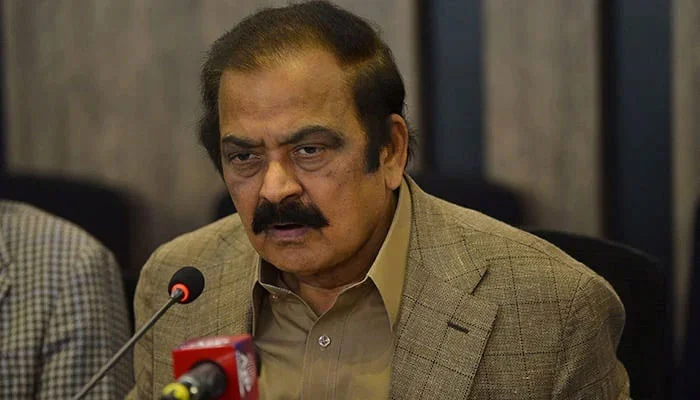
“From their media talk, it is evident that they only want to destabilize and undermine the stability achieved after ‘Marka-e-Haq’ [Pakistan-India clashes] and the success in the government’s efforts for economic revival,” stated Rana Sanaullah, the Prime Minister’s Adviser on Political and Public Affairs, during an appearance on Geo News’ “Geo Pakistan” on Monday.
Sanaullah’s comments refer to Khyber Pakhtunkhwa Chief Minister Ali Amin Gandapur’s press conference a day earlier. Gandapur had termed PTI’s newly launched movement a “do or die” initiative, scheduled to reach its peak by August 5, which would determine the party’s future course of action. Among other objectives, the protest movement aims to secure the release of party founder Imran Khan, who will complete two years in jail on August 5.
During his media talk yesterday, flanked by Salman Akram Raja and other PTI leaders, CM Gandapur, who has previously led multiple marches towards Islamabad, indicated that former PM Khan was prepared to negotiate but insisted that talks should be held with “decision makers.” The outspoken politician remarked, “Negotiate within 90 days and end the [prevailing] issues.”
However, Sanaullah expressed skepticism regarding PTI’s new anti-government drive, labeling it merely an “attempt to destabilize the country.” He stated today, “If they remain peaceful, then it’s fine [as] it’s their democratic right [to protest]. But if they take the law into their own hands and attempt to destabilize the country — which has been their agenda from the beginning — then the law will take its due course.”
The senior Pakistan Muslim League-Nawaz (PML-N) leader’s warning echoes his earlier remarks on Geo News’ “Naya Pakistan” on Sunday. There, he had affirmed that PTI would be permitted to continue its protest if it remained peaceful and presented its viewpoint democratically. Referring to Gandapur’s comments about holding a rally in Lahore, Sanaullah said, “Wherever PTI seeks permission for a rally, the local administration will give it. If the local administration thinks that they will remain peaceful, then it can give permission.”
Regarding the issue of dialogue, he stated that the government is willing to sit down and talk. However, he questioned PTI’s sincerity in holding negotiations while simultaneously launching a fresh protest movement. “If you want to talk, what is the need for this 90-day and August 5 [protest movement] and march towards Lahore?” he questioned.
Furthermore, when asked on “Geo Pakistan” today about potential relief for PTI, Sanaullah responded that the government could not provide any relief given that PTI, during their previous negotiations, had themselves stated they would not discuss Khan’s release, as the former PM desired to be acquitted on merit through the courts.
“It’s their [PTI’s] own stance that they aren’t ready to talk about [Imran] Khan’s release. However, we can surely have parleys on the PTI’s other demands.”
“However, if you see the offer for talks by the PTI, it is not about negotiating with the government, but instead they are still trying to engage the establishment and sort out their matters with them. They are neither ready to sit with other political parties nor with politicians.”
He lamented, “They are still adamant on their agenda, seeking the establishment’s help to bring them back in power. They are not ready for political dialogue.”
When questioned about the government’s objectives for talks, Sanaullah replied: “There is no demand of ours, neither at the party nor at the government level. Our only wish and struggle regarding Pakistan’s progress is its economic revival, and we are ready to sit with the PTI and others to ensure the stability that is needed for this.”
He concluded, “It is in everybody’s mutual interest, the opposition and government’s, and everybody should agree on a ‘charter of economy’ on certain basic matters. And we’re ready for any understanding or agreement in this regard.”
