

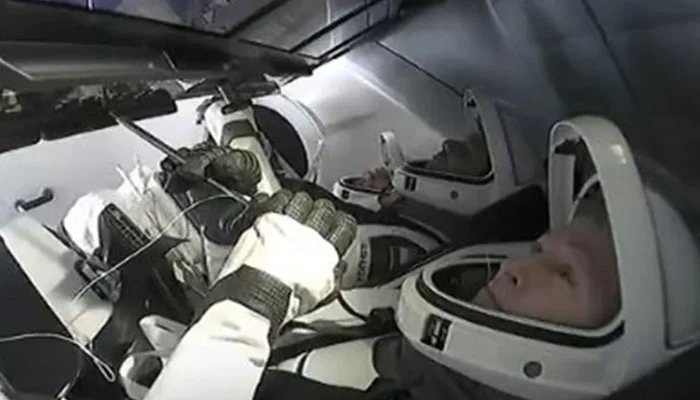
Peggy Whitson, a retired NASA astronaut turned private space explorer, safely splashed down in the Pacific Ocean early on Tuesday, marking her fifth journey to the International Space Station (ISS). She was joined by her crewmates from India, Poland, and Hungary, who were returning from their respective countries’ inaugural ISS missions.
A SpaceX Crew Dragon capsule, carrying the four-member team, parachuted into the calm waters off the Southern California coast at approximately 2:30 AM PDT (0930 GMT). This controlled descent followed a fiery reentry through Earth’s atmosphere, capping a 22-hour journey from orbit.
This return flight concluded the fourth ISS mission organized by Axiom Space, a Texas-based startup, in collaboration with SpaceX, the private rocket venture founded by billionaire Elon Musk and headquartered near Los Angeles. The entire return process was broadcast live via a joint SpaceX-Axiom webcast.
Two sets of parachutes, faintly visible through the darkness and light fog with infrared cameras, effectively slowed the capsule’s final descent to about 15 mph (24 kph) just moments before its splashdown near San Diego.
Minutes prior, the spacecraft had streaked through Earth’s lower atmosphere like a mechanical meteor. This generated immense frictional heat, causing external temperatures on the capsule to soar to 3,500 degrees Fahrenheit (1,927 degrees Celsius). Despite this extreme heat, the astronauts’ flight suits are specifically designed to keep them cool within the cabin.
Diverse Crew and Record-Setting Career
The Axiom-4 crew was commanded by Peggy Whitson, 65, who retired from NASA in 2018 after a distinguished career. Her pioneering achievements include becoming the US space agency’s first female chief astronaut and the first woman to command an ISS expedition.
Immediately after their splashdown, Whitson radioed to mission control that the crew was “happy to be back.” A recovery ship was promptly dispatched to secure the capsule and hoist it from the ocean onto the vessel’s deck. Crew members were then extricated one by one for medical checkups before being ferried to shore, a process anticipated to take about an hour.
Currently serving as the Director of Human Spaceflight for Axiom Space, Whitson has now accumulated 695 days in space, a US record. This cumulative time spans her three previous NASA missions, a fourth orbital flight as commander of the Axiom-2 crew in 2023, and her fifth mission to the ISS commanding Axiom-4.
Completing the Axiom-4 crew were Shubhanshu Shukla, 39, from India; Slawosz Uznanski-Wisniewski, 41, from Poland; and Tibor Kapu, 33, from Hungary.
They returned with a significant cargo of science samples derived from over 60 microgravity experiments conducted during their 18-day visit to the ISS. These samples are slated for shipment to researchers on Earth for final analysis.
For India, Poland, and Hungary, this mission marked their respective countries’ first human spaceflight in over 40 years, and critically, the first time astronauts from their government-funded space programs have ventured to the ISS.
Significance for Future Space Exploration
The participation of Shubhanshu Shukla, an Indian Air Force pilot, is viewed by India’s space program as a precursor to the debut crewed mission of its Gaganyaan orbital spacecraft, which is planned for 2027.
Uznanski-Wisniewski is a Polish astronaut assigned to the European Space Agency, while Kapu is part of Hungary’s Hungarian to Orbit (HUNOR) program. Notably, he is not the first person of Hungarian descent to visit the space station; billionaire Charles Simonyi, a Hungarian-born software designer who became a US citizen, previously visited the ISS twice as a space tourist in 2007 and 2009 via Russian Soyuz capsules. However, unlike Simonyi and other wealthy individuals who self-funded their space travel, Shukla, Uznanski-Wisniewski, and Kapu were flying on behalf of their respective nations’ government space programs.
Dubbed “Grace” by its crew, the newly commissioned Crew Dragon capsule used for Axiom-4 launched from NASA’s Kennedy Space Center in Cape Canaveral, Florida, on June 25, becoming the fifth vehicle in SpaceX’s Crew Dragon fleet.
The Ax-4 team arrived at the ISS on June 26, where they were welcomed by the station’s current rotating crew of seven occupants: three US astronauts, one Japanese crewmate, and three Russian cosmonauts. The two crews parted ways early on Monday as Crew Dragon Grace undocked to begin its journey home.
Axiom-4 also signifies the 18th crewed spaceflight successfully logged by SpaceX since 2020. That year, Elon Musk’s company ushered in a new era for NASA by providing American astronauts with their first rides to space from US soil since the conclusion of the space shuttle program nine years prior.
For Axiom Space, a 9-year-old venture co-founded by NASA’s former ISS program manager, this mission further solidifies its business model of facilitating human spaceflight for astronauts sponsored by private companies and foreign governments into low-Earth orbit.
Axiom is also among a select group of companies actively developing its own commercial space station, intended to eventually replace the ISS, which NASA anticipates retiring around 2030.
