

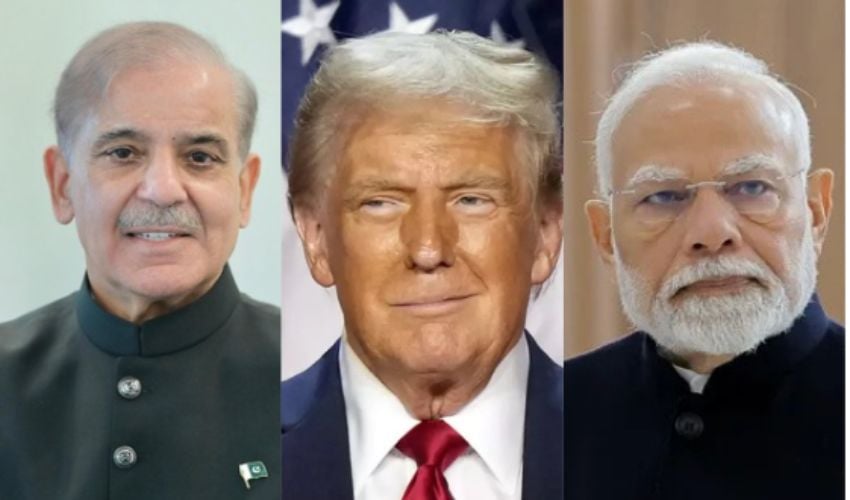
On Wednesday, US President Donald Trump hosted Pakistan’s army chief, Field Marshal Asim Munir, at the White House. This unprecedented meeting carried the risk of exacerbating a disagreement with India over the President’s assertion that he had brokered a ceasefire in last month’s conflict between the nuclear-armed South Asian rivals.
The luncheon was the first instance of a sitting U.S. President hosting the head of Pakistan’s army, widely considered the most influential figure in the country, at the White House without senior Pakistani civilian officials present.
President Trump stated he was honored to meet Munir and that their discussions included Iran, a topic he believed Pakistan understood better than most nations. Trump informed reporters that he had thanked Munir for his role in ending the conflict with India, also commending Indian Prime Minister Narendra Modi, with whom he had spoken on Tuesday night.
“Two very smart people decided not to keep going with that war; that could have been a nuclear war,” Trump told reporters.
According to a statement from Pakistan’s military, the two-hour meeting covered discussions on trade, economic development, and cryptocurrency, as well as an exchange of views on the prevailing tensions between Israel and Iran.
“President Trump expressed keen interest in forging a mutually beneficial trade partnership with Pakistan based on long-term strategic convergence and shared interests,” the army’s statement affirmed.
Pakistani officials and experts had anticipated that Munir would urge Trump not to intervene in Israel’s conflict with Iran and to seek a ceasefire. Notably, a section of Pakistan’s embassy in Washington represents Iran’s interests in the United States, given Tehran’s lack of diplomatic ties with the U.S.
Pakistan has vocally condemned Israel’s airstrikes against Iran, asserting that they violate international law and pose a threat to regional stability.
This meeting signifies a substantial enhancement in U.S.-Pakistan ties, which had largely stagnated under both the Trump and Biden administrations, as both presidents had primarily courted India as part of broader efforts to counter China.
When questioned earlier about his objectives for meeting Munir, Trump told reporters, “Well, I stopped a war… I love Pakistan. I think Modi is a fantastic man. I spoke to him last night. We’re going to make a trade deal with Modi of India. But I stopped the war between Pakistan and India. This man was extremely influential in stopping it from the Pakistan side, Modi from the India side and others. They were going at it – and they’re both nuclear countries. I got it stopped.”
White House spokeswoman Anna Kelly stated that Trump hosted Munir after the latter advocated for the President’s nomination for the Nobel Peace Prize for his alleged role in preventing a nuclear war between India and Pakistan.
Contradictory Mediation Claims
Last month, Trump had claimed that the two South Asian neighbors agreed to a ceasefire following talks mediated by the U.S., and that hostilities ceased when he urged both countries to prioritize trade over conflict.
However, India’s most senior diplomat, Foreign Secretary Vikram Misri, issued a statement clarifying that Prime Minister Modi had informed President Trump during their Tuesday call that the ceasefire was achieved through direct talks between the Indian and Pakistani militaries, not through U.S. mediation.
While Pakistan has expressed gratitude to Washington for its perceived mediating role, India has consistently denied any third-party involvement in the ceasefire. The phone call between Modi and Trump on Tuesday marked their first direct communication since the May 7-10 conflict.
“PM Modi told President Trump clearly that during this period, there was no talk at any stage on subjects like India-U.S. trade deal or U.S. mediation between India and Pakistan,” Misri stated.
He further emphasized, “Talks for ceasing military action happened directly between India and Pakistan through existing military channels, and on the insistence of Pakistan. Prime Minister Modi emphasised that India has not accepted mediation in the past and will never do.”
Misri also mentioned that Modi and Trump were slated to meet on the sidelines of the G7 summit in Canada, but Trump departed a day early due to the Middle East situation. Trump had inquired if Modi could visit the U.S. on his return from Canada, but the Indian leader cited a pre-decided schedule as a reason for his inability to do so.
The most intense fighting in decades between India and Pakistan was triggered by an April 22 attack in Indian Kashmir that resulted in 26 fatalities. New Delhi attributed the attack to “terrorists” allegedly backed by Pakistan, a charge Islamabad denies.
Pakistan had previously stated that the ceasefire occurred after its military returned a call initiated by the Indian military.
On May 7, Indian jets bombed what New Delhi described as “terrorist infrastructure” sites across the border, leading to four days of tit-for-tat strikes involving fighter jets, missiles, drones, and artillery from both sides.
Michael Kugelman, an analyst at the Asia Pacific Foundation think tank, suggested that India-U.S. ties, which have flourished in recent years, could be strained if Trump continues to assert a U.S. role in the ceasefire and offers mediation on Kashmir, a disputed Himalayan territory claimed by both India and Pakistan.
He remarked, “For Delhi, it all boils down to an age-old question: How much can it tolerate U.S.-Pakistan cooperation without having it spoil U.S.-India relations — a partnership that’s thrived in recent years despite continued U.S.-Pakistan links.”
