

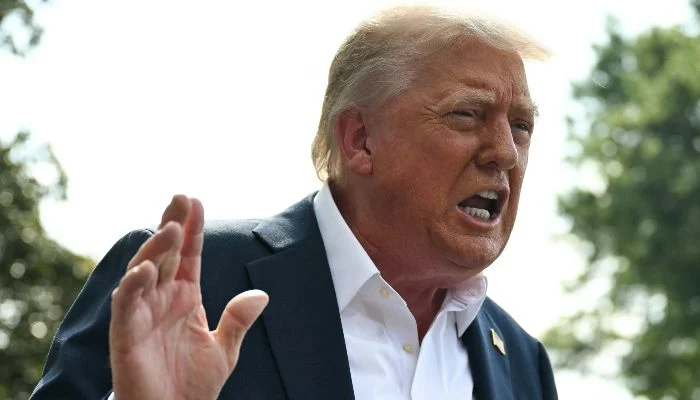
On Sunday, President Donald Trump announced that Washington would send Patriot air defense systems to Kyiv and hinted at new sanctions on Russia. He once again voiced his displeasure with Russian leader Vladimir Putin over Moscow’s ongoing war in Ukraine. The US President’s announcement of these much-needed weapons for Ukraine came after he had previously indicated he would make a “major statement… on Russia” on Monday.
The announcement could coincide with a diplomatic flurry scheduled for Monday, with the US special envoy beginning his latest trip to Ukraine and Trump set to meet with NATO Secretary General Mark Rutte in Washington.
Moscow’s offensive on Ukraine has now lasted for over three years, with attacks intensifying this summer. US-led negotiations to end the fighting have so far yielded no conclusive results.
“We will send them Patriots, which they desperately need,” Trump stated on Sunday, without specifying the exact number of weapons to be sent. “I haven’t agreed on the number yet, but they’re going to have some because they do need protection,” he told reporters at Joint Base Andrews, upon his return from watching the FIFA Club World Cup final in New Jersey.
The White House has reversed an earlier announcement this month that it would pause some arms deliveries to Kyiv. Instead, it has announced a new deal under which NATO will pay the United States for some of the weapons sent to Ukraine. “We basically are going to send them various pieces of very sophisticated military and they’re going to pay us 100% for them,” Trump said. He added, “It’ll be business for us.”
Rutte’s 10:00 am (1400 GMT) Oval Office meeting will be closed to the media, and he is also scheduled to meet with Secretary of State Marco Rubio. Earlier this week, President Volodymyr Zelensky stated that Ukraine was “close to reaching a multi-level agreement on new Patriot systems and missiles for them.”
Trump also reiterated his “disappointment” in Putin, as his exasperation with the Russian leader appears to be growing. “Putin really surprised a lot of people. He talks nice and then he bombs everybody in the evening,” a disgruntled Trump remarked on Sunday. Last week, Trump accused Putin of throwing “bullshit” at Washington regarding Ukraine—openly expressing his frustration with the seeming impasse. When he first returned to the White House in January, Trump had initially insisted he could work with the Russian leader to end the war, holding off on hiking sanctions unlike European allies. However, Russia has for months refused a ceasefire proposed by the United States and Kyiv.
Trump has repeatedly voiced displeasure with Putin in recent days, and on Sunday he hinted that he might finally be ready to toughen sanctions, as momentum grows in Congress for a deterrent package. When asked about whether he would announce any sanctions against Russia, Trump responded: “We’re going to see what we will see tomorrow, OK?” and reiterated his plans to meet with Rutte.
‘Sledgehammer’ Sanctions Bill
Earlier on Sunday, US senators promoted a bipartisan bill that would equip Trump with “sledgehammer” sanctions to use against Russia. Republican Senator Lindsey Graham told broadcaster CBS News that the sanctions bill would allow Trump “to go after Putin’s economy, and all those countries who prop up the Putin war machine.”
Graham added that the bill “would give President Trump the ability to impose 500% tariffs on any country that helps Russia,” suggesting that these could include economies that purchase Russian goods, such as China, India, or Brazil. “This is truly a sledgehammer available to President Trump to end this war,” Graham emphasized.
Zelensky commented on the proposed bill in an X post, stating, “Without a doubt, this is exactly the kind of leverage that can bring peace closer and make sure diplomacy is not empty.”
Graham and Democratic Senator Richard Blumenthal are also scheduled to meet with NATO’s Rutte on Monday night. Blumenthal told CBS News that they would also discuss the legally complex issue of unlocking frozen Russian assets in Europe and the United States for access by Ukraine. “The $5 billion that the United States has also could be accessed, and I think it’s time to do it,” said Blumenthal.
