

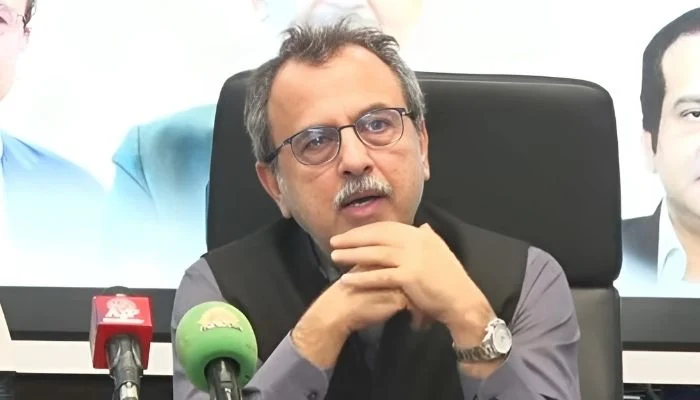
Federal Minister for Power Awais Leghari vowed on Friday that Pakistan’s debilitating circular debt crisis will be eliminated within six years under a landmark financing agreement secured with 18 banks. Crucially, this deal was negotiated on favorable terms and will not impose any additional burden on consumers.
Addressing a press conference, the minister strongly criticized the previous government for dramatically worsening the circular debt problem. He pointed out that when the Pakistan Muslim League-Nawawaz (PML-N) left office in 2018, the debt stood at Rs1,100 billion, but it surged to Rs2.28 trillion during the PTI-led government’s tenure by 2022.
Leghari termed circular debt a “curse” for Pakistan, recalling that by the time the incumbent government took charge last year, the figure had already spiraled to around Rs2.4 trillion.
Reduction Strategy and Financial Discipline
The minister detailed the strategy, noting that the government achieved savings of Rs242 billion through concrete measures like curbing theft, improving recoveries, and enforcing financial discipline. An additional Rs175 billion relief came from an improving economy and reduced interest rates, while the renegotiation of contracts with Independent Power Producers (IPPs) saved a substantial Rs363 billion. Collectively, these measures have resulted in a total reduction of Rs780 billion.
He confirmed that through these reforms, IPP contract renegotiations, and advantageous banking terms, the circular debt stock has already been reduced to Rs1,614 billion as of June 2025.
The government has also finalized a Rs1.225 trillion financing scheme with 18 banks on concessional terms to further address the crisis. “This achievement, negotiated transparently, will ensure that within six years there will be no trace of circular debt,” Leghari stated confidently.
As part of the comprehensive plan, the minister announced that the current surcharge of Rs3.23 per unit paid by consumers would be phased out within five to six years.
Historic Financing Terms and IMF Confidence
Leghari highlighted the historic nature of the financing, which was secured at an interest rate of KIBOR minus 0.9%—the first such deal in Pakistan’s history—projected to save between 3.5% to 5% in interest costs.
He emphasized that the agreement, based on Islamic banking principles, demonstrates the financial sector’s confidence in the government’s reform agenda and had been fully discussed with the International Monetary Fund (IMF).
The minister credited Prime Minister Shehbaz Sharif’s leadership and the joint efforts of federal institutions and Disco boards, whose improved performance is leading to tangible results: losses are decreasing, and the burden on industrial and household consumers is reducing—by up to 38% for industries and 50% for more than 18 million households.
“This is the first time in Pakistan’s history that circular debt is being addressed through a structured plan, transparency, and discipline,” the minister concluded, adding that eliminating circular debt will not only stabilize the power sector but also significantly strengthen the national economy.
