

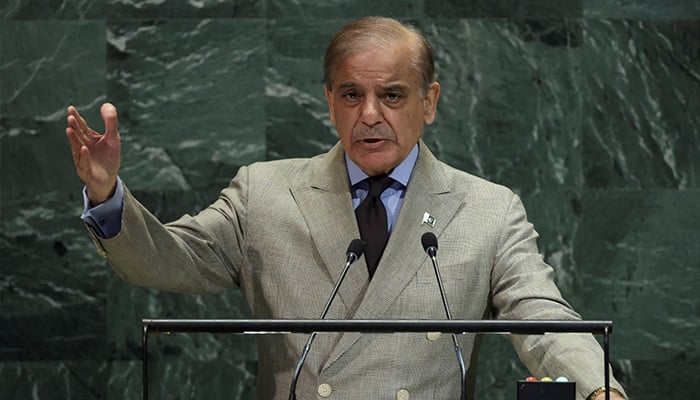
Once dismissed by critics as a “figurehead” merely following the dictates of Pakistan’s powerful establishment, Prime Minister Shehbaz Sharif has, against considerable odds, emerged as one of the country’s most active and impactful leaders on the global stage. From high-level meetings in the corridors of the White House to strategically vital interactions in Riyadh, Beijing, Ankara, Baku, and Tehran, PM Shehbaz has surprised both friends and foes by significantly elevating Pakistan’s diplomatic profile and skillfully steering the nation through some of its most turbulent periods.
Few initially predicted that the man long characterized as an administrator rather than a visionary would so profoundly transform Pakistan’s global standing. Yet, from securing a pivotal defence pact with Saudi Arabia to enhancing Pakistan’s strategic leverage against India and regaining renewed access to Washington’s Oval Office, the premier has decisively rewritten expectations—perhaps even surpassing his own initial projections.
In the view of his top aide, Dr. Tauqir Shah: “In the complex and often turbulent political landscape of Pakistan, few figures have demonstrated the caliber, consistency, and capability that the Prime Minister has exemplified over the decades.” As a seasoned public servant, a hands-on administrator, a coalition-builder, and a development-oriented leader who is extremely deft and experienced in international diplomacy and statecraft, PM Shehbaz stands out as a statesman par excellence—a title not easily earned in a country where political careers are often volatile or dictated by circumstances rather than substance.
Dr. Tauqir, himself a distinguished civil bureaucrat who has worked closely with PM Shehbaz for many years both at the federal and provincial levels, offers unique insight. An official source once revealed that the premier judges everyone’s performance strictly, telling the correspondent, “We remain on tenterhooks while working with him.”
Regarding his work ethic, Dr. Tauqir informed that the Prime Minister prepares for his international engagements with extreme diligence. Any important cypher arriving from any capital is personally reviewed by him within hours the same day. He prepares to the level of perfection for global engagements, often rehearsing his speeches multiple times, reading background papers and briefs in great detail, and meeting with subject matter experts.
Tauqir added, “He also ensures that all ministers and officials dealing with international counterparts are fully prepared.” He pointed out, “From the choice of menu and gifts to cultural and social sensitivities, he pays attention even to minute details while interacting with international leaders.” He credited this meticulous approach for the premier’s ability to “cultivate life-long relationships and friends with foreign leaders.” It was also disclosed that during foreign visits, the premier’s engagements begin at 7:30 in the morning and continue late into the night, and that sightseeing and shopping are a definite NO for his entourage.
While his political career began in the shadow of his elder brother, former Prime Minister Nawaz Sharif, he carved a distinct identity: that of a technocratic, extremely hardworking, disciplined, and solutions-driven pragmatic leader whose focus remained firmly on governance, not just politics.
PM Shehbaz is widely seen as the architect of modern Punjab. His tenures as Chief Minister were defined by a relentless focus on infrastructure development, education reform, good governance, healthcare expansion, and law and order. Achievements like the development of road networks, the Safe City system, the Punjab Food Authority, the Forensic Science Agency, the elite anti-terrorist force, and the Lahore Metro Bus and Orange Line Train projects are all associated with “Shehbaz Speed,” even within his own party. However, Dr. Tauqir stressed that vision and vigilance, more than speed, defined his administration.
Where other politicians made promises, PM Shehbaz rolled up his sleeves and delivered. His governance style included frequent, unannounced visits to public offices, hospitals, and schools, ensuring that service delivery was a reality. He personally led efforts against the Dengue epidemic, polio eradication, natural calamities like floods, and the war against terrorism. He is a rare premier who personally intervened to clinch a near-impossible deal with the IMF in 2022, saving the country from the brink of default.
Furthermore, during the May 2025 stand-off with India, his close coordination with the Army Chief and diplomatic skills ensured that major global powers like China, the USA, and KSA, along with regional countries like Turkey, Qatar, and Azerbaijan, supported Pakistan’s perspective. Similarly, during the recent Iran-Israel conflict, the PM and Army Chief worked closely, standing by the western neighbour without annoying the USA, which instead encouraged Pakistan to use its regional influence for peace.
In the last month alone, PM Shehbaz has been seen meeting and concluding deals with leaders from China, Russia, the ECO, the Kingdom of Saudi Arabia, the GCC, the USA, and many others. Dr. Tauqir highlighted that the skills demonstrated by PM Shehbaz at the global level were previously unfamiliar to many.
According to Dr. Tauqir, PM Shehbaz is multilingual, which is a significant asset in international relations. He revealed that the premier is comfortable conversing in Arabic, even delivering a message on Saudi Arabia’s national day in the language. “He speaks German with ease and once delivered a speech to a large audience in Berlin in German,” Dr. Tauqir added. The PM can even speak functional Russian and engage his counterparts in the Russian language. His skills in Urdu and English are exceptionally good, and he is also proficient in regional languages, including Saraiki and Potowari.
Dr. Tauqir concluded that the PM’s international engagements have significantly improved the country’s image. He has maintained strong ties with strategic allies, emphasising Pakistan’s commitment to peaceful coexistence, regional cooperation, and climate justice.
Dr. Tauqir believes that leadership is tested not in comfort but in crisis. PM Shehbaz, he explained, has navigated economic collapses, natural disasters, political smear campaigns, and governance bottlenecks, yet has rarely resorted to blame games or inflammatory rhetoric. His style is composed, his language measured, and his policies are grounded in pragmatism, not populism.
“Where others chose confrontation, PM Shehbaz chose coalition-building. Where others sowed division, he emphasised unity,” Tauqir said. “To call Shehbaz Sharif a statesman par excellence is not mere flattery — it is recognition of a lifetime spent in service of the people… It is acknowledgment of a leader who, despite political storms and systemic inertia, has kept his focus on delivery, dialogue, and development.” Dr. Tauqir opined that PM Shehbaz remains not just a political figure, but a pillar of experience, a symbol of responsible governance, and a leader for the times.
