

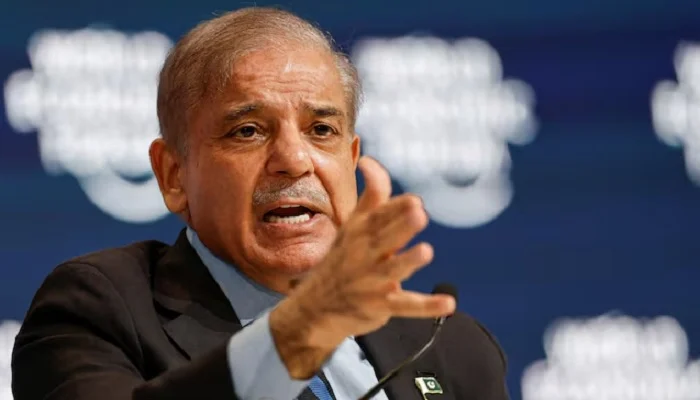
Prime Minister Shehbaz Sharif announced that Pakistan’s economy is achieving stability at the micro level, citing a sharp drop in inflation and reduced interest rates, and lauded overseas Pakistanis for their crucial financial support. Speaking to the media in New York on Saturday after delivering a landmark address at the UN General Assembly (UNGA), he detailed the economic turnaround.
“Just a few years ago, the country faced serious challenges,” he said. “When we took office, inflation was at 32%, and the policy rate was 22.5%. In just one and a half years, inflation has fallen into single digits, and the policy rate is down to 11%. At the micro level, the economy is now stable.”
He praised overseas Pakistanis as “great ambassadors” of the country, noting that they sent $38.5 billion in remittances home in the fiscal year 2024-25 alone. “Their support has been crucial for Pakistan’s economic stability,” he added.
Discussing his recent foreign engagements, the Prime Minister described his reception in Saudi Arabia as “unprecedented in the last 40 years” and termed his meeting with US President Donald Trump “very encouraging.” Responding to a question, he confirmed that the US is ready to invest in Pakistan’s trade, IT, and other sectors.
“During the meeting with President Trump, we discussed the economy, counter-terrorism, minerals, Artificial Intelligence (AI), IT, and cryptocurrency,” the PM said. “I also thanked the US president on tariff issues, while minerals pricing and trade agreements between Pakistan and the US will be decided fairly and in mutual interest.”
Military Victory and Ceasefire
PM Shehbaz also recalled Pakistan’s recent military engagement, stating: “From May 6 to 10, our armed forces bravely defeated India in the war. We shot down seven enemy planes and carried out strikes at Delhi, Pathankot, and many other locations.” He credited Chief of Army Staff (COAS) Field Marshal Syed Asim Munir for his leadership, stating the Field Marshal “guided our forces wisely.”
The Prime Minister revealed the sequence of events that led to a halt in hostilities: “On the morning of May 10, the US Secretary of State Marco Rubio spoke with him [COAS Munir], and we received a message from India that they wanted a ceasefire. We had already won the war. We accepted the ceasefire to avoid further escalation,” he said. Reflecting on India’s subsequent change in attitude, he observed: “Those who once never spoke properly to you are now embracing you, which shows the strength and courage of our armed forces and the victory we achieved.”
Discussions with UN Secretary-General António Guterres
Earlier, PM Shehbaz met UN Secretary-General António Guterres in New York, urging the world body to step up and play a stronger role in tackling global problems. He lauded Guterres’s work in promoting global peace and stability and thanked the UN for acknowledging Pakistan’s flood relief efforts. He stressed that countries hardest hit by climate change need extra support.
He also raised the Kashmir issue, pointing to India’s decision to keep the 65-year-old Indus Waters Treaty (IWT) in abeyance, and urged the UN to ensure fair action. Turning to Gaza, the Prime Minister called for an immediate ceasefire, accelerated aid delivery, and the establishment of a Palestinian state. He affirmed, “Pakistan will continue to work for peace. As a Security Council member, we have to do our part.” Guterres, in response, praised Pakistan’s consistent efforts at the UN and its practical role in maintaining dialogue and stability on global issues.
UNGA Address: A Call for Peace after Conflict
In his landmark address to the UNGA, Shehbaz declared that Pakistan sought peace in the region after delivering a “bloody nose” to India during the May conflict. “We have won the war, and now we seek to win peace in our part of the world, and this is my most sincere and serious offer before this assembly of the world nations,” the Prime Minister stated.
The conflict—the worst between Pakistan and India in decades—erupted following New Delhi’s unprovoked assault on Islamabad after a terrorist attack in Indian Illegally Occupied Jammu and Kashmir, a charge Islamabad vehemently denied.
He recalled his warning from the previous year’s podium: “Last year, from this very podium, I had warned that Pakistan would act — and act most decisively — against any external aggression. Those words of mine proved true.” He then recounted the May aggression: “My country confronted unprovoked aggression from our eastern front. The enemy came shrouded in arrogance; we sent them back in humiliation, delivering a bloody nose.” He concluded that India had sought to extract political gains from a human tragedy by spurning his sincere offer of an independent international investigation into the Pahalgam incident.
Departure via Geneva
Following the conclusion of his US visit, PM Shehbaz departed New York for London, with a planned stop in Geneva. Sources indicated he will visit former Prime Minister Nawaz Sharif in Geneva and brief the Pakistan Muslim League-Nawaz leadership on his trip. Shehbaz is expected to reach London on Saturday for a three-day stay.
