

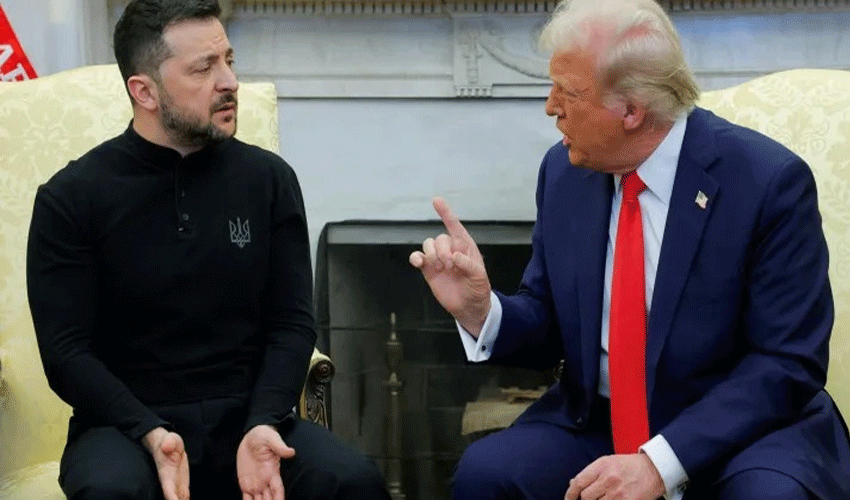
On Monday, U.S. President Donald Trump told President Volodymyr Zelenskyy that the United States would help guarantee Ukraine’s security in any agreement to end Russia’s war, although the details of this assistance remain vague.
Trump made this pledge during an unusual summit at the White House, where he hosted Zelenskyy and a group of European allies after his meeting with Russian President Vladimir Putin in Alaska on Friday.
“When it comes to security, there’s going to be a lot of help,” Trump told reporters, adding that European nations would also be involved. “They are a first line of defense because they’re there, but we’ll help them out.”
Zelenskyy praised the promise as “a major step forward,” stating that the guarantees would be “formalized on paper within the next week to 10 days.” He also mentioned that Ukraine has offered to purchase approximately $90 billion worth of U.S. weapons.
The atmosphere on Monday was much more cordial than the disastrous Oval Office meeting in February, during which Trump and Vice President JD Vance publicly criticized the Ukrainian leader for not being more grateful.
Despite the positive tone, a peace deal still seems distant.
Just before the talks began, Russia’s Foreign Ministry complicated Trump’s offer by ruling out the deployment of NATO troops to secure any peace deal.
Both Trump and Zelenskyy expressed hope that Monday’s meeting would eventually lead to three-way talks with Putin, whose forces are still making slow advances in eastern Ukraine.
In a social media post on Monday, Trump said he had called the Russian leader and started to arrange a meeting between Putin and Zelenskyy, which would be followed by a trilateral summit among the three presidents.
A source from the European delegation said Trump informed the European leaders that Putin had suggested this sequence of meetings.
While the Kremlin has not yet publicly confirmed its agreement, a senior U.S. official said the Putin-Zelenskyy meeting could be held in Hungary. According to German Chancellor Friedrich Merz, the two leaders will meet within the next two weeks.
The last direct talks between Russia and Ukraine were held in Turkey in June. Putin had declined Zelenskyy’s public invitation to meet face-to-face there, sending a low-level delegation instead.
Differing Views on a Ceasefire and New Conditions
In audio remarks on Telegram on Monday, Kremlin aide Yuri Ushakov said that Trump and Putin had discussed “the possibility of raising the level of representatives from the Ukrainian and Russian sides… participating in the mentioned direct negotiations.”
Meanwhile, European leaders—who traveled to Washington to show their support for Zelenskyy—urged Trump to insist that Putin agree to a ceasefire before any talks could progress.
Trump had initially supported this proposal but reversed his position after meeting Putin on Friday. He now aligns with Moscow’s stance that a peace agreement should be comprehensive.
Trump told reporters in the Oval Office that he liked the idea of a ceasefire but that both sides could work on a peace deal while the fighting continues.
“I wish they could stop, I’d like them to stop,” he said. “But strategically that could be a disadvantage for one side or the other.”
Merz and French President Emmanuel Macron voiced support for a ceasefire as a prerequisite for any direct talks with Russia. Macron also said that European leaders would eventually need to be included in any peace talks.
“When we speak about security guarantees, we speak about the whole security of the European continent,” he told Trump.
Trump and Zelenskyy spoke in private before being joined by the European leaders, including heads from Britain, Germany, France, Italy, Finland, the European Union, and NATO, for over two hours of multilateral talks.
A Friendly Tone After February’s Disastrous Encounter
Zelenskyy navigated Monday’s meeting more successfully than his February encounter, which ended abruptly when Trump and Vance publicly scolded him for not being grateful enough. In his opening remarks to the media on Monday, Zelenskyy thanked Trump at least eight times.
This time, Zelenskyy also had support from European leaders who had traveled to Washington to demonstrate solidarity with Kyiv and advocate for strong security guarantees in any post-war settlement.
Trump gave Zelenskyy a warm welcome outside the White House, complimenting his black suit—a change from the Ukrainian leader’s usual military clothes, which media reports said had irritated Trump in February.
When a reporter asked Trump what his message was to the people of Ukraine, he said, “We love them.” Zelenskyy thanked him, and Trump put a hand on his back in a show of affection before they went inside.
Trump’s Pressure and Key Differences
Trump has been pushing for a quick end to Europe’s deadliest war in 80 years. Kyiv and its allies are concerned that he might seek to force an agreement on Russia’s terms, especially after he literally rolled out the red carpet for Putin in Alaska, despite the Russian leader facing war crimes charges from the International Criminal Court. Putin denies these allegations.
Russia maintains it is conducting a “special military operation” in Ukraine to protect its national security, citing NATO’s eastward expansion and Western military support for Ukraine as existential threats. Kyiv and its Western allies, however, call the invasion an act of imperial land grabbing.
Trump has dismissed claims that the Alaska summit was a victory for Putin, who has faced diplomatic isolation since Russia’s 2022 invasion.
According to Trump’s team, both sides must compromise.
However, the president has placed the burden on Zelenskyy, suggesting that Ukraine should abandon its hopes of regaining Crimea, which Russia annexed in 2014, and its goal of joining NATO.
NATO Secretary General Mark Rutte said that while NATO membership for Ukraine was not on the table, there was a discussion about “Article 5”-type security guarantees for the country.
Article 5 of NATO’s founding treaty is the principle of collective defense, where an attack on one member is considered an attack on all. Joining the Atlantic alliance is a strategic objective for Kyiv enshrined in its constitution.
Rutte’s comments indicate that a security guarantee of that scale could be offered to Ukraine as an alternative to NATO membership.
Zelenskyy has already rejected the outline of Putin’s proposals from the Alaska meeting. These included handing over the remaining quarter of the eastern Donetsk region, which is largely controlled by Russia. Any concession of Ukrainian territory would require approval through a referendum.
According to analysts, the war has killed or wounded more than a million people from both sides, including thousands of mostly Ukrainian civilians, and has destroyed vast parts of the country.
