

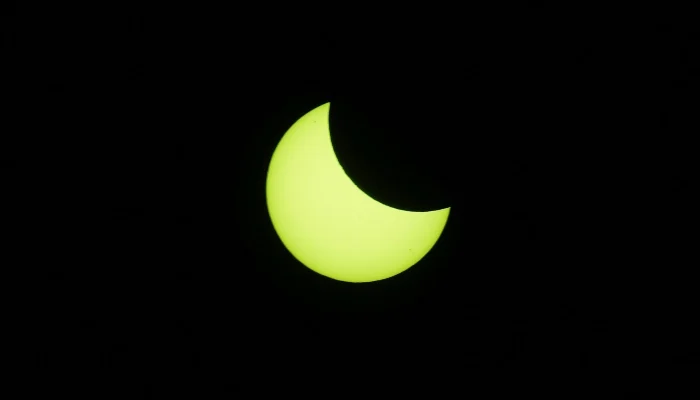
For sky watchers, a partial solar eclipse will cross the skies overnight on September 21-22, the National Aeronautics and Space Administration (NASA) has announced. However, this rare celestial event won’t be visible in the United States, but those in Australia, Antarctica, and across the Pacific and Atlantic Oceans will get a front-row seat.
Unfortunately, Pakistan will miss out. The Climate Data Processing Centre of the Pakistan Meteorological Department (PMD) states that the eclipse will begin at 10:30 PM (PST) on September 21, reach its peak at 12:42 AM, and conclude by 2:54 AM, but the spectacle will remain invisible from anywhere in the country.
According to USA Today, NASA explains that a partial solar eclipse occurs when the Moon passes between the Sun and Earth without a perfect alignment, leaving a glowing crescent of the Sun visible. This will be the second major sky event this month; the first was a total lunar eclipse on September 7-8. And there’s more: the September equinox follows just a day later, on September 22, when day and night are nearly equal worldwide.
Looking ahead, NASA says the next total solar eclipse visible in parts of North America will happen on August 12, 2026, crossing Greenland, Iceland, Spain, Russia, and a small corner of Portugal. A partial eclipse on that date will be visible across North America, Europe, Africa, the Atlantic, Arctic, and Pacific Oceans. Additionally, an annular eclipse is coming on February 17, 2026, visible in parts of Antarctica, with a partial eclipse across Africa, South America, and several oceans.
NASA has one important reminder: never look directly at the Sun without proper eclipse glasses or filters. The agency warns, “Viewing any part of the bright Sun through a camera lens, binoculars, or a telescope without a special-purpose solar filter… will instantly cause severe eye injury.”
