

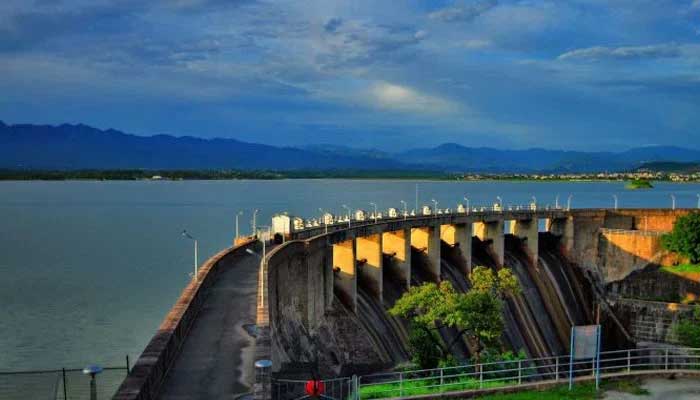
In a Tuesday report by The News, parliamentarians from across the political spectrum expressed concern over the country’s unprecedented flood situation, with multiple voices in the National Assembly calling for the construction of more water reservoirs. Pakistan Tehreek-e-Insaf (PTI) MNA Ali Muhammad Khan proposed a national policy for water storage, while Defence Minister Khawaja Asif advocated for building dams, both large and small, urging lawmakers to set aside political differences on the issue.
The lawmakers’ concerns about the lack of water storage facilities follow widespread flooding in Punjab, caused by torrential rains and water discharge from India. Before Punjab, Khyber Pakhtunkhwa, Gilgit Baltistan, and Azad Jammu and Kashmir were hit by heavy rains, leading to landslides and flash floods that wreaked havoc in the northern parts of the country. According to statistics from the National Disaster Management Authority (NDMA), 874 people have died in various rain and flood-related incidents across the country since June 26. KP has the highest number of fatalities with 488 deaths, followed by Punjab with 216, Sindh with 58, GB with 41, AJK with 37, Balochistan with 26, and Islamabad with eight.
Khawaja Asif recalled that the country’s two largest dams were constructed under a dictator’s regime because they managed to build a consensus, whereas politicians have wasted time on political point-scoring. The defence minister called for the construction of dams. “Raising bigger dams will take 10 to 15 years, but we can at least start with small dams to store water and control the situation,” he said. He emphasized that this is a national issue, and there should be no disagreements, adding that a minimum agenda on which a consensus can be reached should be a priority. “Do not engage in politics and block roads against the construction of water reservoirs,” the minister remarked. He further labeled the unprecedented floods, particularly in Punjab and KP, a man-made disaster, noting that the political elite also shares responsibility. He stated, “Do not call it a natural calamity; rather, it is a man-made disaster caused by the encroachment of riverbeds.”
The National Assembly, suspending its daily agenda, including question hour, held a discussion on the flood situation. The defence minister noted that it was high time for self-accountability as nature and rivers were “taking revenge” for the occupation of waterways and riverbeds. “Everyone has noticed that hotels were also built on riverbeds in Swat and other parts of the province and country,” he said. Asif mentioned that a contractor from his city, Sialkot, who is now a Senate member, had sold plots on the land of nullahs and riverbeds, causing damage to nature. He said in February 2022, the then-deputy commissioner wrote a letter to the Punjab chief secretary, and the “scam” was exposed after floodwater swept away houses constructed on river land. He questioned how much land was reclaimed from the land mafia and how many encroachments were removed in the last three years. He agreed with Ali Muhammad’s proposal for constructing the Mohmand Dam but noted the immediate need for smaller dams that could be built in the shortest time possible.
The PTI MNA called for a unified national response to mitigate the human suffering and property damage caused by the devastating floods. He also called for the devolution of power across the country and a strengthening of the local government system. “We need a comprehensive and robust local government system which can serve people at their doorsteps,” he said, noting that real power devolution has not occurred as powers remain concentrated in provincial capitals. The PTI lawmaker emphasized the urgent need for a national policy on water reservoirs and dams to mitigate the recurring devastation. He shared that he had come directly from the KP House, where the chief minister and other party leaders were meeting on the ongoing crisis. He thanked the speaker for offering prayers for the victims and commended the House for demonstrating unity on the issue. The PTI lawmaker recalled that natural disasters had already hit Buner, Swat, and parts of Mansehra earlier, while Azad Kashmir also suffered heavily. “Now Punjab is facing similar devastation, and this requires the federal government and provincial administrations to stand shoulder to shoulder,” he said. He proposed that Parliament should hold a dedicated session to discuss long-term solutions for water management, particularly the construction of new dams and reservoirs. Referring to past initiatives, he said the Mohmand Dam project was initiated during PTI’s tenure and called upon Prime Minister Shehbaz Sharif’s government to accelerate its work. The PTI MNA urged all political parties to put politics aside on the issue, calling dam construction a matter of national interest. He underlined that no mega-dam of the scale of Mangla or Tarbela had been built for decades, despite the immense need. “This Parliament can give the greatest gift to the nation by framing a comprehensive water storage policy, which will safeguard Punjab, KP, Azad Jammu and Kashmir, and Sindh from recurring floods,” he said, emphasizing that such an initiative would strengthen Pakistan’s future generations.
The Pakistan Peoples Party’s Naveed Qamar stressed the urgent need for a collective national resolve, involving all political parties, to enforce bans on deforestation, river and drain encroachments, and the mismanagement of natural resources. He said that the impacts of climate change were now visible in daily life, with glacial melt, blocked waterways, and unchecked deforestation intensifying disasters. Citing expert warnings, the PPP leader said floods next year could be 22% more destructive, while in the long term, melting glaciers might dry up the Indus and other rivers, turning fertile lands into deserts and threatening centuries-old ecosystems. Qamar said that the Parliament was the only platform to build consensus and guide government action through constructive criticism and solutions. “Politics has its time, but in the face of national calamities, we must rise above partisanship and work together,” he said, adding that flood preparedness must begin immediately.
