

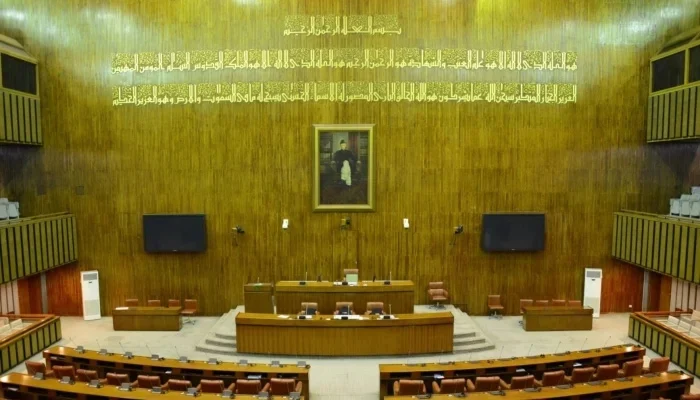
Despite an uproar from the opposition, the Senate on Tuesday passed the Anti-terrorism (Amendment) Bill, 2025, with a majority vote. The bill was approved after lawmakers rejected amendments proposed by Kamran Murtaza of the Jamiat Ulema-e-Islam-Fazl (JUI-F).
Minister of State for Interior and Narcotics Control Talal Chaudhry introduced the bill, which seeks to amend the Anti-terrorism Act of 1997. The legislation had already been approved by the National Assembly.
Murtaza’s proposed amendments were rejected by the House. The bill was then passed through a clause-by-clause reading.
The bill’s statement of purpose says that the current security situation demands a more robust response than what the existing legal framework allows.
The amendments are intended to grant the government, armed forces, and civil armed forces the authority to detain individuals who pose a significant threat to national security.
This provision would allow for the preventive detention of suspects based on credible information or reasonable suspicion, helping to disrupt terrorist plots before they are carried out. It would also provide legal support for Law Enforcement Agencies to conduct more effective operations against terrorism.
The bill also facilitates the use of Joint Interrogation Teams (JITs), comprising members from various law enforcement and intelligence agencies, to conduct thorough inquiries and gather actionable intelligence.
Additionally, the Upper House of Parliament unanimously passed two other bills: the Pakistan Land Port Authority Bill, 2025, and the Petroleum (Amendment) Bill, 2025.
The Pakistan Land Port Authority Bill was introduced by the Minister of State for Interior, while the Petroleum (Amendment) Bill, 2025 was presented by Minister for Petroleum Ali Pervaiz Malik.
‘We Don’t Want Terrorists Roaming Freely’
Responding to lawmakers’ concerns, Minister for Law and Justice Azam Nazeer Tarar said that the country is currently facing the threat of terrorism and that amendments proposed by PPP’s Syed Naveed Qamar have already been incorporated to make the bill more effective.
He added that the bill has also passed judicial scrutiny and includes a three-year sunset clause. The minister stated that the amendment aligns with the original spirit of the 1973 Constitution and that under its Clause 2, a detainee must be presented before a judge within 24 hours.
Senator Irfan Siddiqui of PML-N stressed that no leniency should be shown toward terrorism. “We do not want terrorists roaming freely while innocent people are slaughtered… These acts weaken our federation and create mistrust between the people and the state,” he stated.
Senator Siddiqui urged lawmakers to view the anti-terrorism legislation in its proper spirit, as the country has lost nearly 100,000 lives to terrorism. He added that such laws can not only prevent crime but also curb forced disappearances and arbitrary detentions.
He also voiced his concern about the political victimization and mistreatment of political leaders, recalling his own arrest and imprisonment. “When I saw Fawad Chaudhry with a cloth over his face, I stood in this House and said this should not happen. Today, when I see Shah Mehmood Qureshi in handcuffs, I feel the same grief,” he said, emphasizing that he cannot support such treatment for anyone.
Barrister Syed Ali Zafar of PTI said that his party is also against terrorism but believes some clauses of the bill are unconstitutional and should be referred to a committee for review.
PTI’s Noorul Haq Qadri and JUI-F’s Kamran Murtaza also suggested that the bill be sent to the standing committee and the Council of Islamic Ideology for their input.
Amendments to Petroleum Law
According to the Petroleum (Amendment) Bill, 2025, the government will use information technology and real-time monitoring to digitally track petroleum products and oversee their reserves. The delivery of petroleum products to filling stations and storage facilities will also be tracked in real-time.
The legislation introduces strict penalties for illegal activities. A fine of Rs1 million will be imposed for unlawfully importing, transporting, storing, refining, or blending petroleum. Repeat offenses will incur a penalty of Rs5 million. For unlicensed storage or sale of petroleum, deputy commissioners will have the authority to seize machinery, materials, storage tanks, and the products themselves, with the owner facing a fine of up to Rs10 million.
The bill also provides a six-month grace period for licenses that have expired or been canceled. The Explosives Department is required to renew licenses within one month of receiving an application, and any delay will require the concerned officer to provide reasons. An appeal can be filed with the Secretary of the Petroleum Division if a license is not renewed.
For those found storing or selling smuggled petroleum products, their licensed storage facilities will be sealed. All machinery, equipment, and vehicles used in the sale or transport of smuggled fuel will be confiscated. Offenders will face a Rs100 million fine and the cancellation of their license.
The legislation makes it clear that affected parties will have the right to challenge these actions in court. The bill’s statement of purpose notes that the IT-based tracking system is being introduced to curb the smuggling of petroleum products and that deputy commissioners are being empowered to ensure effective enforcement.
