

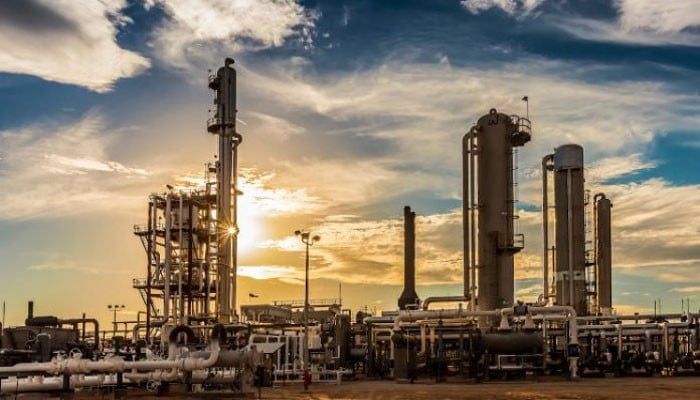
Pakistan’s industrial output has witnessed a significant growth of 5.02% in the first four months of the current fiscal year, according to the latest data released by the Federal Bureau of Statistics. The growth rate is a result of a 3.75% increase in industrial output in October compared to September.
The data reveals that the production of automobiles has increased by 78.89% during the period of July to October. Similarly, the production of transport equipment has seen a growth of 37.51% during the same period. The production of food groups has also seen a growth of 5.02% during the period of July to October.
The production of tobacco has increased by 2.10%, textiles by 1.58%, and wearing apparel by 4.69% during the period. The production of coal and petroleum has increased by 12.25% during the four-month period. However, the production of rubber products has seen a growth of 12.03% during the period, while machinery and equipment saw a decline of 11.95%.
The production of furniture has declined by 16.46% during the period, while the production of pharmaceuticals has declined by 6.68%, chemical products by 1.90%, and iron and steel by 3.25%.
The All Pakistan Sarraf Hazaar Association has reported that the price of gold has increased to Rs. 4,56,162 per tola following the increase in industrial output.
In other news, the UK is set to introduce a new rule that will allow banks and credit card companies to impose a cap on contactless payments without requiring a PIN code from March next year. The Commissioner of Karachi, Amjad Hafeez, has conducted a survey of sugar mills in various divisions of Punjab to assess the price of sugar.
The Chairman of the Crypto Council, Bilal Bin Thaqib, has met with the Governor of the State Bank, Jamil Ahmed, to discuss the progress of crypto regulation in Pakistan. The price of gold in the international market has decreased by $9, resulting in a price of $4,325 per ounce.
The 100 Index closed at 1,71,960 points on Friday, following a meeting of the Economic Coordination Committee chaired by the Minister of Finance, Miftah Ismail. The meeting also approved the establishment of 5,000 new schools and the allocation of funds for youth development programs.
The President of the Karachi Chamber of Commerce and Industry, Rehman Hafeez, has written a letter to the Ministry of Maritime Affairs. The Bank of England has reduced its interest rate to 3.75% from 4%, following a decision by the Monetary Policy Committee.
The World Bank’s Country Director, Boluroma Amagobazar, has met with the Federal Minister for Petroleum, Ali Haider Zaidi, in Islamabad. The price of gold in the international market has increased by $22, resulting in a price of $4,334 per ounce.
The services sector has recorded a trade deficit of $180 million, while the income deficit stands at $740 million. The overall trade deficit has decreased by 14.5% to $3.33 billion. The State Bank of Pakistan has reported that the current account surplus stood at $10 billion in November, while the current account deficit stood at $29 billion in October.
A strike by goods transporters has disrupted the arrival and departure of ships at the port. The Nepalese government has introduced a new policy, known as the Nepal Solar Consumers Act 2025, which aims to promote the use of solar energy.
A group of people traveling in a barat wore identical clothing, according to a report. The document states that 50 Barrett sniper rifles, 100 sniper rifles, and 1,250 modern automatic weapons ‘TWS’ will be purchased.
New Zealand’s Tom Latham and Devon Conway have set a new record in Test cricket. The flight took off from the Blue Origin launchpad in Texas, USA.
Australia has won the Ashes series by taking a 3-0 lead in the five-match Test series.
