

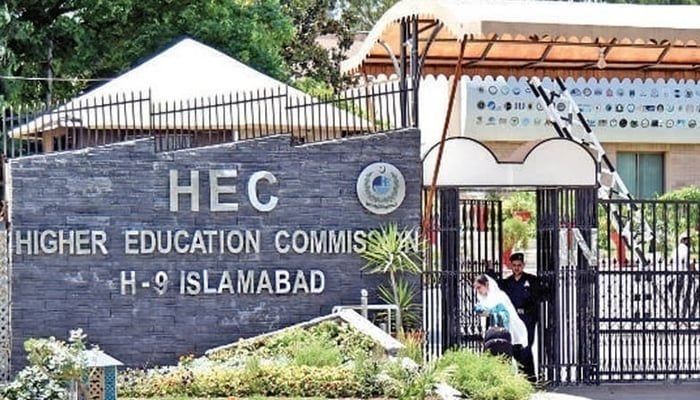
Dr. Mukhtar Ahmed, Chairman of the Higher Education Commission (HEC), has stated that while Pakistan’s education system possesses the “ingredients” to rank among the world’s top universities, it suffers from a lack of proper governance, which contributes to the decline of its universities in global rankings.
His comments were made earlier this week during an appearance on Geo News’ “Geo Pakistan” program, in response to a recent survey that revealed no Pakistani university made it into the global top 350.
According to the latest statistics from the global university ranking organization QS (Quacquarelli Symonds), Quaid-e-Azam University and the National University of Science and Technology (NUST) are the highest-ranked Pakistani institutions, at 354th and 371st globally, respectively. The University of Karachi, the country’s largest university, barely secured a spot in the top 1,001, with no other university from Sindh ranking within the top 1,500. This outcome has led to questions about the role and quality of private universities.
Many private institutions, despite charging exorbitant fees, are reportedly far from achieving global recognition. This raises significant concerns regarding the value of degrees obtained, particularly for students considering international opportunities after paying substantial tuition.
Progress and Persistent Problems: Dr. Mukhtar Ahmed on Pakistan’s Universities
Despite the somewhat grim news, Dr. Ahmed highlighted a positive development: 18 Pakistani universities have entered the global top 1,000, a notable improvement from just three universities in 2019.
He reiterated that Pakistan possesses the inherent “ingredients” for a more robust educational system. “The nation has produced graduates who have excelled globally, even outperforming individuals from much larger countries,” he stated. However, he emphasized that the key lies in addressing three to four fundamental issues.
He identified “governance” as the most critical challenge. “Improving governance within educational departments is a crucial step towards resolving many existing issues,” Ahmed asserted.
The second major problem he identified was “quality.” He explained, “While universities now have autonomy and are under provincial administration, the HEC’s role is limited to providing a system and minimum standards.”
Furthermore, Ahmed pointed out that the perception of universities becoming mere “employment exchanges” rather than centers of academic excellence is another significant challenge for the education sector to overcome.
Additionally, he stated that investment in Pakistan’s education sector has been “inconsistent,” characterized by fluctuating budgets since 2002. He highlighted that the development budget for education has been reduced, further widening the gap between Pakistani universities and their global counterparts. “The budget of even a single top 500 university in the West often surpasses the entire higher education budget for one university in Pakistan.”
He called for “ownership and investment” in the youth to empower Pakistani universities to compete with the world’s best institutions.
