

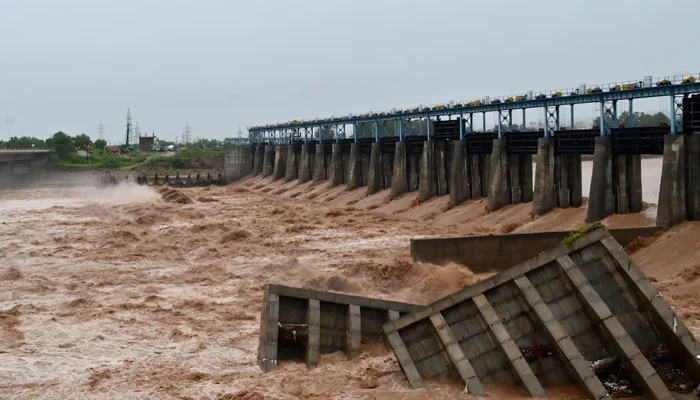
Pakistan is facing an unprecedented and severe flood situation, a crisis that has been intensified by the abrupt release of water from Indian dams. This emergency has been further complicated by India’s decision to suspend the Indus Waters Treaty (IWT), an agreement that has regulated shared water resources for over six decades.
As Pakistan struggles with these record floods, concerns are growing over India’s alleged failure to abide by the IWT. There are accusations that New Delhi has not upheld its crucial duty to provide timely flood warnings, especially as Pakistan’s Chenab, Ravi, and Sutlej rivers have reached dangerously high flood levels.
The 1960 Indus Waters Treaty obligates both India and Pakistan to follow specific protocols to prevent material damage from water flows. Article IV-8 explicitly states, “Each Party agrees to communicate to the other Party, as far in advance as practicable, any information it may have in regard to such extraordinary discharges of water from reservoirs and flood flows as may affect the other Party.” Furthermore, Article IV-9 outlines each party’s commitment to “operate its storage dams, barrages and irrigation canals in such manner […] as to avoid, as far as feasible, material damage to the other Party.”
However, India has reportedly not consistently met these obligations. For example, while an alert for a potential flood in the Tawi tributary of the Chenab River was shared with Pakistan on Sunday (August 24, 2025), there was a critical failure to provide updated information about the Sutlej River. By the time the Tawi alert was issued, the Sutlej had already reached high flood levels, exceeding 122,000 cusecs. This left lower riparian South Punjab with insufficient time to prepare for the surging waters.
This alleged lapse in information sharing is particularly alarming given India’s unilateral decision on April 23, 2025, to suspend the Indus Waters Treaty. Shortly after putting the IWT in abeyance, India deliberately reduced outflows from reservoirs on the Chenab River to minimum levels, causing a serious water shortage during high irrigation demand. In response, Pakistan was forced to release water from the Mangla Dam to compensate for the shortfall in the Chenab’s water supply.
As previously reported, India’s unilateral suspension of the IWT has halted the formal exchange of crucial data and cooperative mechanisms, leaving Pakistan with less advance notice to manage its rivers and mitigate flood impacts.
The combined effect of heavy monsoon rains and these unannounced or delayed water releases from Indian dams is worsening the country’s water crisis, threatening its agricultural sector, economic stability, and water security. This could potentially lead to widespread food insecurity and public unrest as the humanitarian situation deteriorates.
A recent report from the Flood Forecasting Division, issued at 9 pm on Wednesday, August 27, paints a grim picture. The Chenab, Ravi, and Sutlej rivers are all experiencing dangerously high flood levels. The Chenab River is at an extremely high flood level at all four of its monitoring sites, with a massive outflow of 1,077,951 cusecs recorded at Qadirabad. Similarly, the Sutlej River is at an exceptionally high flood level at Ganda Singh Wala, while the Ravi River is at a high flood at Shahdara.
This devastating flood comes on the heels of India’s April announcement to hold the IWT in abeyance. This unprecedented move has effectively stopped the formal sharing of crucial hydrological data and cooperative mechanisms. Without this vital information, Pakistan is left with less advance warning to manage water flows and mitigate flood risks—a practice its officials have long relied upon.
An official stated that the formal flood alert shared by India in recent days was not helpful in taking timely precautionary measures. This was partly because, unlike previous practice, India did not share data on releases from all of its water reservoirs on the eastern rivers.
In a situation where outflows from the upper riparian are uncertain, the river inflows downstream highlight the precarious state of water management. This underscores the need for precise coordination and monitoring to mitigate potential flood risks and ensure optimal water utilization.
While the Indus River at the Tarbela Dam, the Jhelum River at the Mangla Dam, and the Kabul River at Nowshera show moderate and stable flows, other key rivers, especially those originating from or passing through India, are under immense pressure.
The Chenab River at Marala has high inflows of 769,500 cusecs, with almost equal outflows. Downstream barrages are also managing high flows, including Chashma Barrage (inflows of 305,700 cusecs) and Taunsa Barrage (inflows of 345,200 cusecs).
The ongoing floods threaten to severely impact the country’s already struggling agricultural sector, which forms the backbone of its economy. The crisis poses a significant risk to national economic stability and food security, and could lead to public unrest as the humanitarian situation worsens. With continued heavy monsoon rains and the suspension of the IWT’s data-sharing mechanism, Pakistan is facing a severe water crisis.
