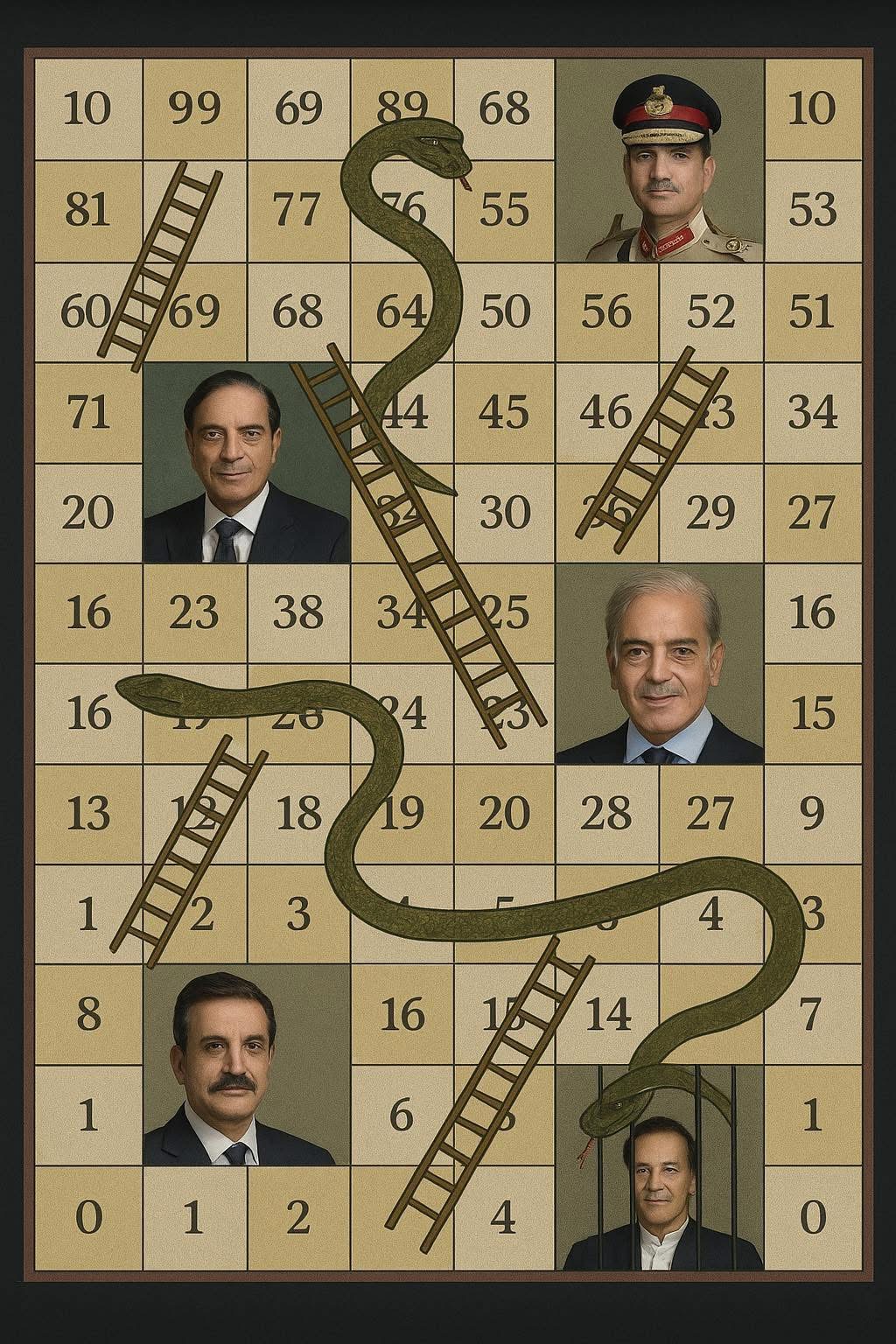
Pakistan’s Constitutional Snakes and Ladders: A Nation Waiting to See Whether the Next Move Climbs a Ladder—or Falls into a Serpent’s Mouth
By Raja Zahid Akhtar Khanzada
Centuries before a modern republic called Pakistan existed, Indian mystics designed a game to teach children the moral geometry of life. A hundred-square board. Ladders of virtue lifting the soul upward. Serpents of sin dragging it back into darkness. Moksha Pattam was never simply a pastime; it was a philosophical rendering of fate itself, of how character and chance wrestle for dominion, of how triumph often disguises defeat, and how defeat sometimes becomes a lesson etched in the heart.
Faith, generosity, knowledge, these were the ladders.
Arrogance, deceit, greed, lust, these were the serpents.
The final square was salvation.
But to reach it, one needed more than luck. One needed the courage to climb.
Today, Pakistan stands before its own version of that ancient game, a constitutional snakes and ladders played not on a wooden board but on the very architecture of the state. Each new amendment rises like a ladder. Each ambiguity coils beneath like a patient serpent. Decisions climb; notifications fall. One wrong step rewrites the balance of power; one overlooked clause pulls the entire system back to square one.
The Constitution, once a map, has become the board itself.
Act I: The Silent Ladder — The Twenty-Sixth Amendment
It began quietly. The Twenty-Sixth Amendment stretched the tenure of service chiefs without the need for signatures, summaries, or proclamations. When the deadline of November 29, 2024 passed without a notification, the Constitution spoke on its own: the Army Chief’s term had already extended to 2027.
No file moved.
No pen shifted.
No meeting assembled.
It was as though a ladder sprouted silently in one of the squares, and the player ascended without even noticing the climb.
Act II: The Board Flips — The Twenty-Seventh Amendment
Then came the Twenty-Seventh Amendment, a sweeping reconstruction of Pakistan’s military and judicial architecture.
The Chairman Joint Chiefs vanished.
The Chief of Defence Forces emerged.
The Supreme Court’s dominion shrank.
A new Constitutional Court appeared like a fresh square drawn onto the board.
The President and the Field Marshal were granted a permanent constitutional stature.
It felt as though the final act of the game had arrived and someone had flipped the board upside down.
Power did not just shift, it redefined its own boundaries.
And in that redefinition lay both a ladder and a serpent.
Act III: Two Clocks, Two Paths, One Player
If the Field Marshal becomes CDF, his new tenure would begin from the date of notification, extending to 2030. Yet under the Twenty-Sixth Amendment, the Army Chief’s five-year term naturally ends in 2027. And should another extension be granted, the line stretches further, all the way to 2032.
A single individual suddenly inhabits:
Two clocks.
Two legal eras.
Two constitutional realities.
It is a ladder from which the Constitution removes the possibility of descent.
The square of return, where ordinary players find serpents waiting,no longer exists for this office.
Act IV: A Fortress of Immunity
The CDF cannot be removed by the Prime Minister, the cabinet, or the courts.
Only impeachment, the rarest of political storms, can unseat him.
Four provincial assemblies.
The National Assembly.
The Senate.
All with two-thirds concurrence.
And if new provinces are formed tomorrow, the path grows longer still.
This immunity does not shield an office, it shields a person.
Once elevated, the descent becomes structurally impossible.
Even the presidency lies open. The constitutional barrier of a two-year cooling period for government servants entering politics has been struck down. The upper squares of the board are now aligned, waiting.
The game seems designed so that once the climber reaches the top, no serpent can touch him.
Act V: The Supreme Court’s Narrowing Path
The Twenty-Seventh Amendment placed the Supreme Court in a narrowing corridor. Its constitutional jurisdiction was curtailed. The suo motu ladder disappeared. A new court the Federal Constitutional Court , absorbed the disputes that once shaped national destiny.
Yet this new court is born from amendments it cannot question.
It holds the pen, but the pages remain folded.
A paradox drawn in legal ink.
This is the square where the silent serpent lifts its head.
Act VI: The Missing Notifications — And the Three Timelines
The greatest mystery is not political, it is temporal:
Why were the CDF and COAS notifications not issued on November 29?
Two interpretations now hover:
If counted from 2022 → the term ends in 2027.
If counted from 2025 → the term extends to 2030.
If the CDF notification comes → the path stretches to 2032.
A single step determines whether the climber rises, or falls.
Act VII: Strategic Command Suspended in Midair
The National Strategic Command , reimagined with new terms, extensions, and unchallengeable authority, stands ready to reshape the military spine. But without the CDF notification, the entire structure hangs midair.
Like a ladder erected without its first rung.
Act VIII: Two Legal Universes, One State
If the COAS and CDF notifications are not issued together, with coherent legal grounding, Pakistan could split into two constitutional worlds:
Two timelines.
Two narratives.
Two institutional claims.
A burden heavy enough to reshape the coming decade.
Act IX: The Missing Amendments — A Ladder Placed in the Wrong Square
The government insists that all three service laws — Army, Air Force, Navy — have been amended and gazetted. Yet only the Pakistan Army Amendment Act 2025 exists in the public record.
The other two remain hidden, inaccessible, or possibly unfinished.
A missing square.
A misplaced ladder.
A serpent drawn where none was intended.
Najam Sethi alone hinted at what the government did not say: this was not a conspiracy, but a mistake, born of haste, oversight, and the failure to understand the depth of legal symmetry required.
Act X: The Outer Noise — A Game Played by Those Not in the Game
Outside the state, a different storm rises. From the United States and the United Kingdom, PTI vloggers and YouTubers have turned this constitutional ambiguity into political oxygen.
Where there is only legal silence, they imagine revolt.
Where there is procedural delay, they predict mutiny.
Where there is technical incoherence, they forecast collapse.
They cut, twist, and reassemble the analysis of Pakistan’s most seasoned commentators into fantasies of ladders that do not exist.
In their game, they always stand on square ninety-nine.
But on the actual board, truth remains square zero.
A wrong notification, a wrong date, a wrong reading, and the serpent opens its jaws.
The future shifts in the fog.
Epilogue: The Prisoner, the Poem, and the Board
As the 26th, 27th, and the soon-expected 28th Amendments redraw the constitutional landscape, political observers watch the board with sharpened eyes. Yet far away, Prisoner No. 804 and his online warriors see this entire saga as a war for their own fate, though they cannot move a single piece on the board.
And the poem that echoes in their hearts feels as though it was written for this very moment:
ya jo sanp sedhi ka khel hay.
abhi sath the ham donon
wah bhi ek par
min bhi ek
ise sedhi mali
majhe raahil min hi dis liya gaya.
mere bakht ke kasi sanp ne
badi dur se plana
zakhami ke apane naseeb ka
wah aajane pohch gaya.
min das ke pher min ghar.
In these lines lies the ache of politics, the satire of destiny, and the eternal truth of the game itself:
A single step lifts one player skyward.
The same square sends another spiraling back.
Pakistan now stands beneath a constitutional sky, a new line drawn beneath its feet.
The next move will decide everything.
Will it be a ladder?
Or the serpent’s mouth?