

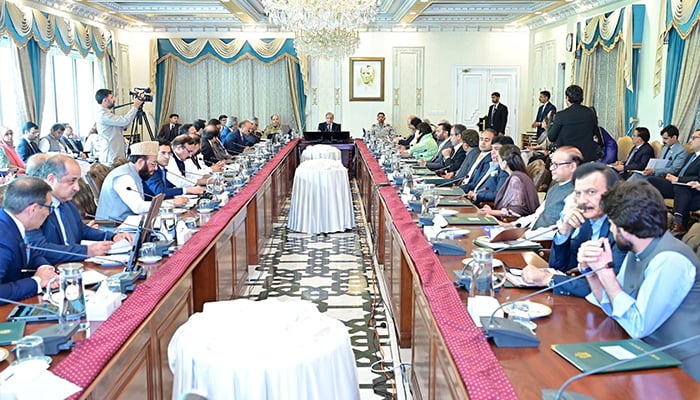
Prime Minister Shehbaz Sharif on Wednesday announced significant reforms as the federal cabinet unanimously approved two landmark initiatives—the National Artificial Intelligence (AI) Policy 2025 and the Hajj Policy 2026—during a high-level meeting in Islamabad.
The cabinet unanimously endorsed the AI policy, which aims to cultivate a comprehensive AI ecosystem across Pakistan. It sets ambitious targets, including training one million AI professionals by 2030 and developing 1,000 indigenous AI products within five years. The policy also encompasses the launch of 50,000 civic projects, the provision of 3,000 annual scholarships, and the facilitation of 1,000 research projects.
“Our youth are Pakistan’s greatest asset. Providing them with education, skills, and equal opportunities in AI is a top priority,” stated PM Shehbaz. The policy additionally promises inclusive education and financing for women and differently-abled individuals, guarantees national cybersecurity, and aligns local standards with international AI regulations. A dedicated AI Council, supported by a Master Plan and Action Matrix, will oversee its implementation. The government also intends to establish AI Innovation and Venture Funds to foster private sector participation.
PM Shehbaz lauded the Ministry of IT and affiliated departments for their timely contributions. He asserted, “AI will not only modernize our economy but also enhance productivity across agriculture, public services, and governance.”
Digital Transformation of Hajj Operations
Separately, the Cabinet approved the Hajj Policy 2026, which mandates the complete digitization of the pilgrimage process, beginning in 2026. Under this policy, 70% of pilgrims will be accommodated through the government scheme, while the remaining 30% will utilize private operators, who will now be subject to stricter accountability.
Private Hajj companies that failed to fulfill their obligations in the previous year are now required to facilitate those same affected pilgrims in 2026. Key improvements outlined include real-time tracking, digital wristbands, mobile applications, SIM cards, and a revised compensation mechanism. The Ministry of IT will collaborate with the Ministry of Religious Affairs to ensure the seamless digital transformation of Hajj operations.
Federal Minister for Religious Affairs, Sardar Muhammad Yousaf, addressed the media, discussing key developments and policy decisions regarding Hajj arrangements. He confirmed that the Ministry of Religious Affairs will formally respond to the Senate Standing Committee’s sub-committee concerning its recent report on Hajj operations. He criticized the sub-committee for not taking the ministry into confidence during the preparation of its report.
He acknowledged that some private Hajj tour operators’ failure to deposit pilgrim payments on time led to complications last year. To address this, private tour operators will now be required to offer Hajj to affected pilgrims at last year’s costs.
He further added that a financial eligibility criterion has been introduced for private operators to ensure transparency, and a neutral third party will monitor both government and private Hajj schemes.
The Hajj selection process will now operate on a first-come, first-served basis, and only pilgrims with Saudi-approved vaccinations will be permitted. The “Road to Makkah” facility will be available at both Islamabad and Karachi airports.
Additionally, the ministry will provide comprehensive training to pilgrims and establish emergency response teams. An effective financial oversight system and a transparent grievance redressal mechanism will also be implemented. Furthermore, the Hajj Nazim Scheme will continue, and children under 12 years of age will not be allowed to perform Hajj. Yousaf also confirmed that the ministry has synchronized its Hajj policy with Saudi Arabia’s timeline, with implementation set to commence from August 4th.
