

Pakistan expressed concern on Friday over the limited flood-related data shared by India, stating that the information provided this year through diplomatic channels was not as detailed as in the past.
This statement comes amid one of the country’s most disastrous floods, after India opened all gates of major dams following warnings issued to Pakistan via diplomatic channels, including one given today, rather than through the relevant forum of the Indus Waters Treaty (IWT) last month.
Under the treaty, New Delhi is obligated to issue flood alerts for three rivers that flow into Pakistan from India. In a weekly briefing today, Foreign Office Spokesperson Shafqat Ali Khan noted that India did not use the Indus Water Commissioner’s channel to share the information. He urged New Delhi to fully comply with all provisions of the treaty.
Catastrophic Flooding and Rising Toll
A family with their belongings takes refuge on a rooftop near the Chenab River in Wazirabad, Punjab province, Pakistan, following monsoon rains and rising water levels.
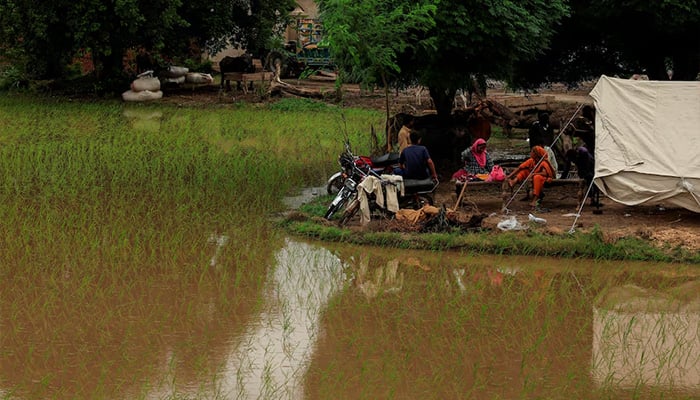
For the second time in three years, catastrophic monsoon floods have carved a path of destruction across Pakistan’s northern and central regions, particularly in its Punjab province, submerging villages, drowning farmland, displacing millions, and killing hundreds. According to the latest statistics from the National Disaster Management Authority (NDMA), Pakistan has recorded 905 deaths since late June when the monsoon season began. The floods have swept into 1,400 villages in Punjab and led to the evacuation of more than a million people.
After the devastation in Punjab, torrents are now heading towards Sindh, which is preparing to cope with a “super flood” in its riverine areas.
India’s Dispute with the IWT
It is noteworthy that India had suspended its participation in the IWT with Pakistan after the killing of 26 civilians in Indian Illegally Occupied Jammu and Kashmir, which New Delhi blamed on Islamabad. Pakistan denied the charges, which led to the worst fighting between the countries in decades before a ceasefire was agreed upon last week.
In June, the Permanent Court of Arbitration’s Supplemental Award asserted that India has no authority to unilaterally suspend the agreement. The unanimous judgment, delivered on June 27, 2025, and binding on both parties without appeal, confirmed that India’s unilateral decision to place the treaty in abeyance has no bearing on the Court’s competence to adjudicate the matter.
What is the Indus Waters Treaty?
The nuclear-armed neighbors disagree over the use of water from rivers that flow downstream from India into the Indus River basin in Pakistan. The use of this water is governed by the Indus Waters Treaty, which was mediated by the World Bank and signed by the neighbors in September 1960.
The agreement divided the Indus and its tributaries between the two countries and regulated water sharing. India was granted the use of water from three eastern rivers—the Sutlej, Beas, and Ravi—while Pakistan was granted most of the water from the three western rivers—the Indus, Jhelum, and Chenab. There is no provision in the treaty for either country to unilaterally suspend or terminate the pact, which has clear dispute resolution systems.
