

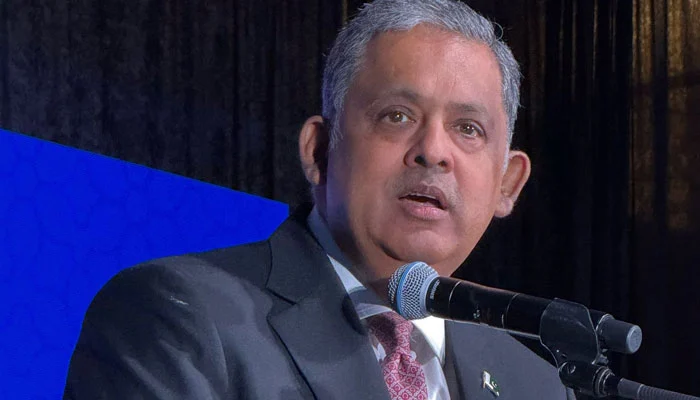
Pakistan’s Ambassador to the US, Rizwan Saeed Sheikh, has called on President Donald Trump to intervene and help de-escalate rising tensions with India, warning that “any misadventure or miscalculation can lead to a nuclear confrontation.”
Speaking to Fox News Digital, the ambassador described the region as a “nuclear flashpoint,” suggesting that President Trump could play a significant role in resolving the standoff between the two nuclear-armed nations.
“It could be an important part of President Trump’s legacy to address this situation, not with a temporary solution, but by tackling the core issue — the Kashmir dispute,” he stated.
Saeed criticized India’s response to the Pahalgam attack in Indian Illegally Occupied Jammu and Kashmir (IIOJK), labeling it “dangerously premature and inflammatory.”
“Within minutes of the attack, India began leveling accusations against Pakistan,” he said, noting that a post-investigation report was filed just 10 minutes after the incident, despite the remote and challenging terrain near the scene.
The ambassador warned that the region, home to over 1.5 billion people, is once again being held “hostage to the war of hysteria” by India’s government and media, who immediately “started beating the drums of war.”
He cited Pakistan’s request for evidence linking it to the attack and Islamabad’s offer to participate in a neutral, transparent inquiry — both of which have gone unanswered.
“Any misadventure or miscalculation can lead to a nuclear confrontation,” the ambassador said. “That is certainly not desirable in such a densely populated region.”
The ambassador stated that the suspected individuals are reportedly Indian nationals whose homes have already been raided. He questioned why India is looking beyond its borders rather than addressing what he characterized as “administrative shortcomings” in Jammu and Kashmir.
He also criticized India’s broader policies in Kashmir, including the settlement of non-residents into the region, and threats to unilaterally block water flows from Pakistan’s rivers — a move he described as a violation of the long-standing Indus Waters Treaty.
“That is as grossly illegal as it can get,” said Saeed, adding: “This is one treaty that has withstood wars between India and Pakistan.”
Pakistan has stated that it would consider the cutting off of water supplies an act of war and has appealed to The Hague, accusing New Delhi of water terrorism. The ambassador called on nations around the globe to assist in a lasting settlement.
“Previously, when the situation has reached this level or tensions have escalated, the international community has addressed the situation, but diverted their attention before the situation could fully de-escalate,” said Saeed.
“This time, perhaps it would be timely, given the similar situations elsewhere on the globe that are being addressed, to not offer a temporary solution, but to tackle the broader problem.”
Saeed said Pakistan has lost between 70,000 and 90,000 lives over the past 20 years to terror attacks. “We cannot afford any instability in the neighborhood,” he remarked.
“We want a peaceful neighborhood. But as we have repeatedly mentioned at all levels, leadership and otherwise, we want peace, but that should not be misconstrued as a sign of weakness. We want peace with dignity,” added the ambassador.
