

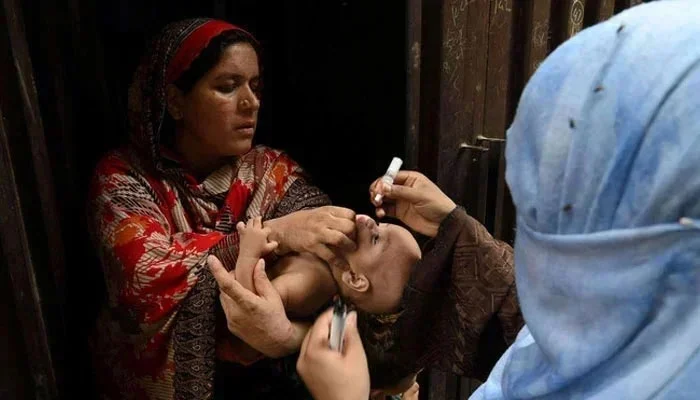
Pakistan has reported its 13th polio case of 2025, raising renewed alarms about the persistent circulation of the poliovirus in high-risk areas. The latest case involves an 18-month-old girl from Union Council Amakhel, District Tank in South Khyber Pakhtunkhwa (KP), confirmed by the Regional Reference Laboratory at the NIH. This marks the seventh case from KP province this year.
Case Distribution Across Pakistan
Beyond Khyber Pakhtunkhwa, polio cases have also been reported in other regions:
- Sindh: Four cases
- Punjab: One case
- Gilgit-Baltistan: One case
Earlier in the week, the Regional Reference Laboratory at NIH Islamabad also confirmed a case of wild poliovirus in a 33-month-old boy from KP’s Bannu district.
Poliovirus Detected in Environmental Samples
Adding to the concern, the Pakistan Polio Eradication Programme recently reported the detection of poliovirus in environmental samples collected from seven different districts across the country. The virus was found in samples from:
- Quetta
- Gwadar
- South Waziristan (Lower)
- South Waziristan (Upper)
- Larkana
- Rawalpindi
- Mirpurkhas
On a positive note, environmental samples collected from Pishin and Lahore were declared free of the poliovirus, a welcome development in the fight against the crippling disease. These samples were part of environmental surveillance efforts conducted between May 8 and 23, with a total of nine sewage samples collected from nine districts.
Challenges and Vaccination Efforts
Polio remains a highly infectious disease, primarily affecting children under five, and can lead to paralysis or death. While there is no cure, vaccination is the most effective preventive measure. Pakistan is one of only two polio-endemic countries globally, alongside Afghanistan. Although the number of cases had significantly dropped in recent years, the country is now experiencing a concerning spike.
Southern KP continues to pose a significant challenge due to access issues and barriers to house-to-house vaccination, leaving many children vulnerable and unvaccinated.
Despite these hurdles, national vaccination campaigns are actively underway:
- In 2025, three national campaigns (in February, April, and May) have successfully reached over 45 million children.
- These efforts are supported by a vast network of 400,000 frontline workers, including 225,000 female vaccinators.
Last month, the Pakistan Polio Eradication Programme officially launched its third National Immunisation Days (NIDs) campaign for the year, reiterating its commitment to making Pakistan a polio-free nation.
In 2024, Pakistan reported a total of 74 polio cases, with Balochistan accounting for 27, Sindh 23, Khyber Pakhtunkhwa 22, and one case each from Punjab and Islamabad.
Given the ongoing challenges in southern KP and the detection of the virus in environmental samples, what additional strategies do you think are crucial for Pakistan to overcome the remaining barriers to polio eradication?
