

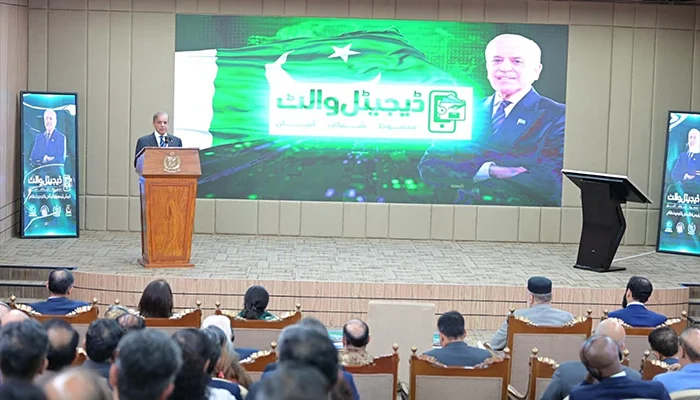
On Monday, Prime Minister Shehbaz Sharif launched a system of 10 million digital wallets for beneficiaries of the Benazir Income Support Programme (BISP), hailing it as a historic milestone for Pakistan’s path toward a more transparent, financially inclusive, and cashless economy.
With a symbolic palm touch, the prime minister inaugurated the system in the presence of federal ministers, BISP leadership, and international partners, including GIZ. He congratulated BISP Chairperson Senator Rubina Khalid, her team, and partner organizations for this “landmark decision that will protect genuine recipients from unnecessary difficulties.”
PM Sharif stated that the digital wallet system is, “in its true sense, blessed by the soul of Shaheed Mohtarma Benazir Bhutto, as it empowers BISP beneficiaries with safe, transparent, and direct access to financial assistance.” He emphasized that BISP remains a “great initiative for poverty alleviation and employment generation” but stressed that continuous efforts are needed to expand its impact.
The prime minister called the launch “a great leap toward a cashless economy.” He recalled that during Ramadan, 78% of the relief package was successfully distributed through digital channels despite skepticism and resistance from vested interests. He remarked that cashless transactions are a “pressing requirement of our times” because they save time, end corruption, and increase efficiency, helping Pakistan progress rapidly. PM Sharif revealed that he personally chaired multiple meetings on digitization despite initial “indifferent attitudes and boredom” on the issue, underscoring his resolve to transform government, business, and personal transactions into digital channels.
PM Sharif urged BISP leadership to integrate education and health conditions into the program. He suggested that assistance should be linked to the condition that all children in a recipient household attend school, and health initiatives should be tied to BISP support. “Only then will this program become a true legacy benefiting millions of children,” he said, calling for the existing eight-to-ten-month implementation cycle to be reduced to just four months. The premier concluded by paying tribute to all stakeholders, the State Bank of Pakistan, the IT Ministry, Pakistani banks, and development partners for their contributions. “We are not just disbursing aid, we are raising an army of architects and workers to build the nation,” he said.
Earlier, BISP Federal Secretary Amir Ali Ahmed briefed that under the prime minister’s direction, a high-level committee was formed to ensure transparency and ease of access in the digital system. “After today’s launch, 10 million digital wallets will be developed using beneficiaries’ CNICs, supported by a biometric verification system to prevent identity theft,” he said. He added that 10 million free SIM cards would also be distributed, with the first phase already underway in Hyderabad, Sukkur, and Rahim Yar Khan in collaboration with a cellular company.
The BISP chairperson termed the launch an “important and historic milestone” in Pakistan’s social protection journey. “This program, which supports over 10 million impoverished families, is not just financial assistance, it is a pathway to social and economic empowerment,” she said. She noted that linking benefits to women’s CNICs provides them with recognition and inclusion in the national database. The new wallets, she added, would “open further opportunities” and be supported by digital literacy programs for women beneficiaries who are unfamiliar with the technology. Senator Rubina highlighted that BISP is a continuation of Benazir’s vision for women’s empowerment, a dream carried forward by President Asif Ali Zardari and now “excelling further under Prime Minister Shehbaz Sharif’s leadership.”
