

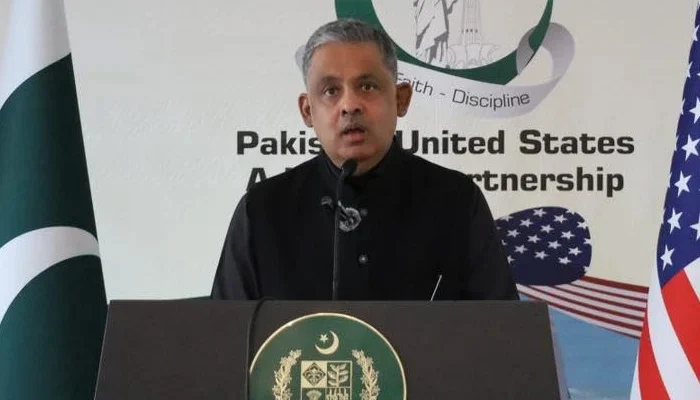
Pakistan’s Ambassador to the US, Rizwan Saeed Sheikh, stated that Islamabad is experiencing no pressure from Washington to recognize Israel. He shared this during an informal media briefing at a luncheon hosted by Dr. Rao Kamran Ali, a prominent Pakistani-American community leader, at his residence in Dallas. Addressing the gathering, the ambassador discussed a range of national and international issues, emphasizing that Pakistan’s stance on Israel remains constant and is grounded in the philosophy of the nation’s founder, Quaid-e-Azam Muhammad Ali Jinnah. Ambassador Sheikh noted, “Our approach to Israel is consistent with Quaid-e-Azam’s principles,” adding that Pakistan’s position is based on long-standing guidelines and is not influenced by external forces.
The event was attended by many notable Pakistani-American figures, including Democratic leader Tahir Javed, Pakistan’s Consul General in the US Aftab Chaudhry, and numerous physicians and professionals from across the country. These remarks occur amidst international media speculation regarding evolving relationships between the Muslim world and Israel. Pakistan, which lacks diplomatic relations with Israel, maintains that normalization can only happen following a just resolution to the Palestinian issue. During the recent confrontation between Middle Eastern rivals Iran and Israel, Pakistan supported Tehran’s right to self-defense against Israeli aggression.
Commenting on bilateral ties, Ambassador Sheikh confirmed that Pakistan-US relations are improving, mentioning that both countries are striving to strengthen collaboration in areas such as commerce, energy, and technology. He indicated that a significant dialogue on counterterrorism between Pakistan and the United States is anticipated soon, and there has been encouraging progress in the economic and trade relations between the two countries. Ambassador Sheikh further noted that following a recent high-level meeting between US President Donald Trump and Pakistan’s Field Marshal General Syed Asim Munir, new opportunities for cooperation have emerged, and bilateral ties have been enhanced.
Regarding trade matters, he stated that ongoing discussions are taking place between relevant authorities in both countries concerning Pakistan’s exemption from additional tariffs, acknowledging that while progress is promising, the issue is complex and requires time. In response to a query about investment prospects, he highlighted that Pakistan possesses ample electricity reserves to support ventures like cryptocurrency mining—a growing sector in the global digital economy. Federal Minister for Planning Ahsan Iqbal also addressed the gathering via video link, sharing insights into Pakistan’s current political, economic, and defense landscape and detailing new government initiatives and strategic visions. Host Dr Ali concluded the event by announcing that he, alongside Dr Javed, intends to invest in Pakistan’s information technology sector, specifically in artificial intelligence. He expressed gratitude to all distinguished guests and attendees for their participation.
It is worth noting that Pakistan officially commenced the drafting of a comprehensive regulatory framework for digital and virtual assets last month, signaling the government’s significant move to formally oversee the burgeoning cryptocurrency ecosystem. Subsequently, Islamabad and New York each launched dedicated Crypto Councils to promote the responsible growth of the digital asset sector. Earlier this month, the federal cabinet formally approved the summary for establishing the Pakistan Virtual Assets Regulatory Authority (PVARA), a step toward creating a legal and institutional framework for overseeing the country’s digital assets ecosystem. As the country increases efforts to modernize its financial system, State Bank of Pakistan (SBP) Governor Jameel Ahmad also stated that the central bank is preparing to launch a pilot program for a digital currency and is finalizing legislation to regulate virtual assets. Central banks globally are exploring the use of digital currencies as interest in blockchain-based payments expands. Pakistan’s initiative follows similar steps by regulators in China, India, Nigeria, and several Gulf states to test or issue digital currencies through controlled pilot programs.
