

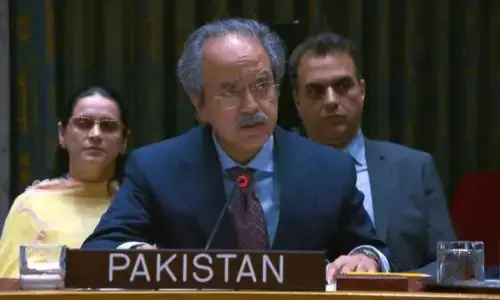
During a UN Security Council meeting on Afghanistan, Ambassador Asim Iftikhar Ahmed, Pakistan’s Permanent Representative to the UN, stated that groups like Al Qaeda, IS-Khorasan, TTP, the East Turkestan Islamic Movement (ETIM), and Baloch insurgent groups such as the BLA and Majeed Brigade continue to operate with impunity from Afghan soil.
Ambassador Ahmed shared that Pakistan has “credible evidence of collaboration among these groups through joint training, illicit weapons trade, refuge to terrorists and coordinated attacks.” He added that over 60 terrorist camps function as hubs for infiltration, targeting civilians, security forces, and development projects inside Pakistan.
The Digital Threat and Counter-Terrorism Efforts
The envoy also noted that the threat has extended to cyberspace, where nearly 70 propaganda accounts traced to Afghan IP addresses are spreading extremist messages. He emphasized that “curbing these networks requires full cooperation from social media platforms with governments.”
Ambassador Ahmed told the council that Pakistan and China have jointly requested the Security Council’s 1267 Sanctions Committee to designate the BLA and Majeed Brigade as terrorist organizations. He urged the Council to act swiftly on this request to curb their activities. He also highlighted the TTP, describing it as the largest UN-designated group on Afghan soil with nearly 6,000 fighters.
Pakistan has thwarted multiple infiltration attempts and seized caches of sophisticated military equipment abandoned by international forces in Afghanistan. These efforts have come at a heavy cost; he noted that just this month, 12 Pakistani soldiers were martyred in a single incident.
The Situation in Afghanistan and Pakistan’s Role
He pointed out that while four years of Taliban rule have ended decades of civil war in Afghanistan, the country remains struggling with sanctions, poverty, narcotics, and human rights concerns. He expressed regret that the UN’s 2025 Humanitarian Needs and Response Plan has received only 27% of its required $2.42 billion.
The ambassador reminded the Council that Pakistan has hosted millions of Afghan refugees for over four decades, often with insufficient international assistance.
