

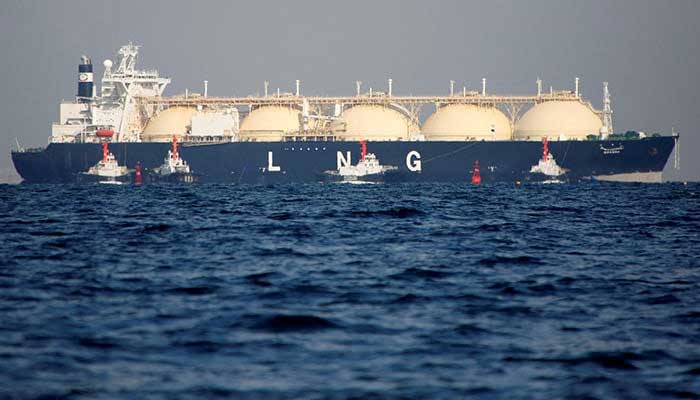
Federal Minister for Petroleum, Pervaiz Malik, has cautioned that Pakistan could encounter a surplus of imported Re-Gasified Liquefied Natural Gas (RLNG) if the power sector fails to utilize its committed volumes. The News reported that the government is exploring various solutions, including supply diversion, to avert potential stockpiles. “There will be no surplus RLNG if the power sector takes its committed volume,” Malik stated, emphasizing the critical need for enhanced coordination across the entire energy supply chain.
Malik also advocated for a merit-based composition of the Cabinet Committee on Energy (CCOE), urging the inclusion of the Finance, Power, and Petroleum ministries. He remarked, “Nominations to the Cabinet Committee on Energy should be based on merit instead of personal like or dislike.”
Commenting on potential US crude oil imports, Malik indicated, “We will look to the import of American crude with open mind,” noting that the WTI benchmark was currently more economical than other crude grades like Brent.
Malik revealed that the closure of Pakistan’s border with Iran due to regional tensions has led to a significant surge in legal fuel consumption in Balochistan, which he described as a clear indicator of widespread past smuggling. “In June 2024, the oil supply in Balochistan was 8,500 tonnes for the entire month. After the border closure in June 2025, that same volume was consumed in just one week,” he explained, adding that he had requested Ogra to provide data on Iranian oil smuggling.
The minister also mentioned that a high-level ministerial committee is evaluating options concerning potential waivers for oil and gas imports from Iran amidst ongoing tensions. He further noted that Pakistan and Iran continue to engage in arbitration proceedings in Paris regarding the long-stalled Iran-Pakistan (IP) gas pipeline project.
Regarding LNG, Malik admitted that the second LNG contract with Qatar has created complications. “If there has not been such LNG contract, we might not be facing the current situation of default in the gas sector,” he stated, highlighting that the government was forced to suspend 300mmcfd of local gas production.
Defending the recent increase in fixed gas charges, Malik cited financial constraints. He explained, “Rs150 billion subsidy to protected gas consumers in addition to Rs250 billion RLNG diversion from power to domestic consumers compelled the government to increase the fixed charges.” He added, “We are in IMF program which wants zero deficit.”
He supported the concept of a unified Energy Ministry and underscored the Petroleum Division’s crucial role in decision-making. On the geopolitical front, Malik stated that Pakistan has invited China, Russia, and the US to invest in its mining sector. “We are offering equal opportunities,” he affirmed, rejecting any accusations of favoritism.
Concerning refinery upgrades, he criticized the imposition of regulated margins and zero-rating tax policies, warning that these measures jeopardize $6 billion in planned investment. “Undue burden should not be put on refineries if the government wants them to invest $5-$6 billion,” he cautioned.
