

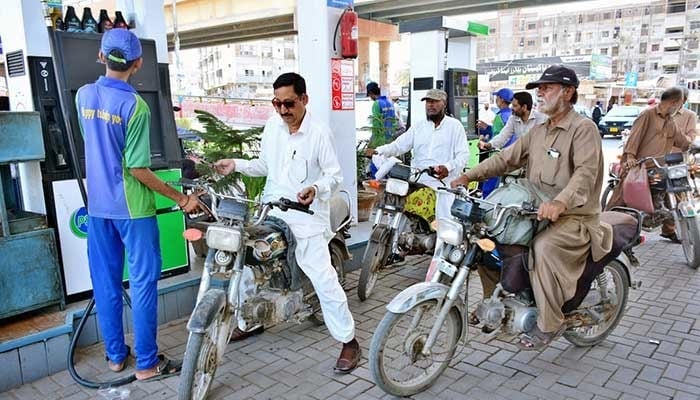
Amid devastating floods caused by cloudbursts, landslides, and flash floods across Punjab—with potential spillover effects into Sindh—Pakistan is expected to see a slight reduction in petroleum product (POL) prices starting September 1. This will provide only minimal relief to consumers.
Official estimates suggest that petrol prices may drop by Re0.61 per liter, while high-speed diesel (HSD) could see a larger cut of Rs3.13 per liter. Kerosene oil is projected to decrease by Rs1.57, and light diesel oil (LDO) by Rs2.61 per liter.
These price adjustments are a result of a marginal decrease in global crude oil prices. Brent crude was recorded at $67.30 per barrel on August 16, rose to $68.18 on August 18, and then fell to $66.73 by August 27. This limited softening in international markets has shaped Pakistan’s local pricing outlook.
Accordingly, the new price for petrol may be set at Rs264.00 per liter (down from Rs264.61), HSD at Rs269.86 per liter (down from Rs272.99), kerosene oil at Rs176.70 per liter, and LDO at Rs159.55 per liter.
The price cuts occur against the backdrop of projections from leading global institutions. Goldman Sachs forecasts Brent to average between $60–$66 per barrel for the remainder of 2025, potentially falling into the low $50s in 2026 if supply surpluses materialize. Similarly, the US Energy Information Administration (EIA) expects Brent prices to dip below $60 per barrel in Q4 2025, with levels hovering around $50 throughout 2026 due to rising global inventories and output.
The current price of petroleum products includes a significant petroleum levy, carbon levy, freight burden, customs duty, and deemed duty. Consumers currently pay a petroleum and carbon levy of Rs80.52 per liter on petrol and Rs79.51 on HSD. An Inland Freight Equalisation Margin (IFEM) of Rs8.05 on petrol and Rs6.20 on HSD is also included. The premiums are $6.37 per barrel on petrol and $3.20 per barrel on HSD.
Despite the disaster-struck landscape, this marginal reduction in POL prices may offer a small financial respite to households and industries that are already struggling with high inflation and disrupted supply chains.
