

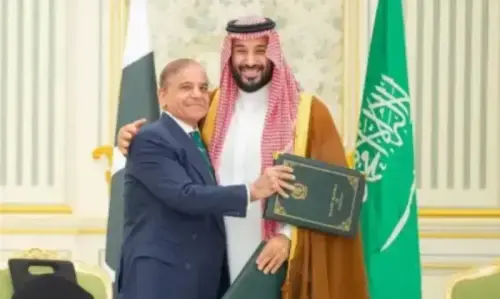
Prime Minister Shehbaz Sharif arrived in Riyadh for a one-day visit yesterday, where he and Crown Prince Mohammed bin Salman signed a “Strategic Mutual Defence Agreement” at the Al-Yamamah Palace. In a post on X (formerly Twitter), the Prime Minister shared his appreciation for the warm reception he received from his “dear brother HRH Prince Mohammed bin Salman.” He said the welcome, from the “unprecedented escort provided to my aircraft by the Royal Saudi air force jets” to the “smartly turned out guard of the Saudi armed forces,” spoke volumes about the deep bond and mutual respect between Pakistan and Saudi Arabia.
The Prime Minister said his “most cordial talks” with the Crown Prince covered a wide range of topics, including regional challenges and enhanced bilateral cooperation. He expressed his deep admiration for the Crown Prince’s “vision and leadership” in the Muslim world and said he “greatly values” his “consistent support and keen interest” in expanding Saudi investments and business ties with Pakistan. PM Shehbaz ended his post with a prayer for the friendship between the two nations to “continue to flourish and attain new heights of glory. Inshallah!” According to state broadcaster Radio Pakistan, the Prime Minister left for London today after concluding his visit.
The Defence Agreement
Pakistan and Saudi Arabia have a long-standing, multi-faceted relationship built on strategic military cooperation, mutual economic interests, and a shared Islamic heritage. This partnership has included economic assistance and energy supplies, with Riyadh being a significant source of financial aid and oil for Islamabad. Wednesday’s agreement marks the most important upgrade in Pakistan-Saudi defense ties in decades.
The pact’s signing was announced in a joint statement from Islamabad and Riyadh, which said it “reflects the shared commitment of both nations to enhance their security and to achieve security and peace in the region and the world.” The statement added that the agreement “aims to develop aspects of defence cooperation between the two countries and strengthen joint deterrence against any aggression,” without providing further details. Critically, the text emphasized that “any aggression against either country shall be considered an aggression against both.”
The timing of the accord, which follows an Arab summit that signaled a shift toward collective security in the wake of Israel’s attacks on Qatar, suggests it is rooted in current world affairs and reflects the defense concerns of both nations.
Defense cooperation between the two states dates back to 1967 and deepened after the 1979 Grand Mosque seizure, when Pakistani special forces assisted Saudi troops. In 1982, a Bilateral Security Cooperation Agreement was formalized, allowing for Pakistani training, advisory support, and troop deployments in Saudi Arabia. At one point, as many as 20,000 Pakistani troops were stationed in the kingdom, and Saudi Arabia became a major buyer of Pakistani-made arms.
In recent years, the partnership has gained urgency due to regional instability. The new pact formalizes commitments that were already in practice, creating what some analysts see as a de facto joint defensive umbrella, although its finer details were not made public.
For Pakistan, the agreement offers both strategic and economic benefits. It secures crucial Saudi investment and funding during a time of fiscal strain while reinforcing Islamabad’s role as an Islamic security provider. For Saudi Arabia, it strengthens its defenses against threats from Iran and Houthi militias, as well as the regional instability caused by Israel’s actions in Gaza and aggression against other neighboring countries.
Pakistan’s earlier defense alignments, such as those with the US during the Cold War and under SEATO and CENTO, have long since dissolved. Today, while partnerships with China, Turkey, and other Gulf states are important, they lack mutual defense clauses. In this context, Wednesday’s agreement is Pakistan’s most significant formal defense commitment in decades, tying its security role to the evolving strategic architecture of the Gulf.
