

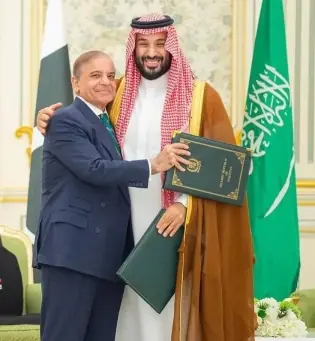
On Wednesday, Prime Minister Shehbaz Sharif and Saudi Crown Prince Mohammad Bin Salman signed the ‘Strategic Mutual Defence Agreement’ at the Al-Yamamah Palace in Riyadh. According to a joint statement released at the end of the PM’s one-day visit, the pact “reflects the shared commitment of both nations to enhance their security and to achieving security and peace in the region and the world.”
The statement, without providing specific details, said the agreement “aims to develop aspects of defence cooperation between the two countries and strengthen joint deterrence against any aggression.” Crucially, the text emphasized that “any aggression against either country shall be considered an aggression against both.” The timing of this accord, which follows a recent Arab summit and Israel’s attack on Qatar, suggests it is rooted in current global affairs and addresses the defense concerns of both nations.
A high-level Pakistani delegation accompanied the Prime Minister, including Deputy Prime Minister and Foreign Minister Ishaq Dar, the Chief of Army Staff Field Marshal Asim Munir, and several other key ministers. PM Shehbaz’s plane was escorted into Saudi airspace by F-15 fighter jets, and a special ceremony was held at the royal palace before the talks began.
The agreement is considered the most significant upgrade in Pakistan-Saudi defense ties in decades. The two countries’ cooperation in this area dates back to 1967 and deepened after the 1979 Grand Mosque seizure, when Pakistani special forces assisted Saudi troops. In 1982, a Bilateral Security Cooperation Agreement was formalized, which enabled Pakistani training and troop deployments on Saudi soil. This new pact formalizes these long-standing commitments, creating what some analysts see as a de facto joint defensive umbrella.
For Pakistan, the agreement offers both strategic and economic benefits. It helps secure vital Saudi investment and funding during a time of fiscal strain while reinforcing Islamabad’s role as a pan-Islamic security provider. For Saudi Arabia, it strengthens its defenses against threats from Iran, Houthi militias, and regional turbulence caused by Israel’s actions in Gaza. Unlike Pakistan’s Cold War-era alliances with the United States or its current partnerships with China and Turkey, this agreement includes a binding mutual defense clause, making it Islamabad’s most consequential formal defense commitment in decades.
To celebrate the accord, the Capital Development Authority illuminated prominent buildings in Islamabad with green lighting, including the Supreme Court, Parliament House, and other key government and commercial buildings.
In a separate event on Wednesday, PM Shehbaz also inaugurated ‘Pakistan TV Digital’, a new English news channel. He said the channel’s purpose is to give Pakistan’s perspective on global developments, counter anti-Pakistan narratives, and provide authentic coverage. The Prime Minister also recorded his first interview for the new channel.
