

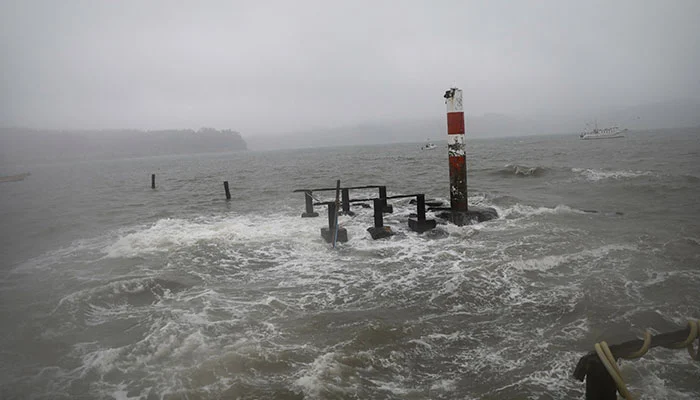
On Wednesday, a formidable 8.8 magnitude earthquake struck off Russia’s Kamchatka Peninsula, forcing residents across the Pacific to quickly gather belongings and flee for their lives. This colossal seismic event triggered widespread tsunami alerts, extending from Japan to South America, resulting in waves crashing into port areas, the closure of beaches, and widespread disarray as millions urgently sought higher ground.
The earthquake was categorized as one of the strongest ever recorded, generating towering waves reaching up to four meters (12 feet) in height. Despite its immense power, the initial quake caused limited damage and only minor injuries, even though it was the most potent seismic event since 2011, when a devastating earthquake and tsunami claimed 15,000 lives in Japan. However, tsunami warnings were issued for over a dozen countries, placing millions of residents on high alert.
In Russia, a tsunami surge swept through the port of Severo-Kurilsk, inundating the local fishing plant, according to officials. Footage broadcast by Russian state television depicted buildings and debris being carried out to sea. Mayor Alexander Ovsyannikov reported that the surge of water extended approximately 400 meters inland, reaching the town’s World War II monument.
In Japan, nearly two million people were advised to evacuate to higher elevations before the warnings were subsequently downgraded or rescinded. The Fukushima nuclear plant in northeast Japan—which was severely damaged by a massive earthquake and tsunami in 2011—was evacuated, as confirmed by its operator. Local media reported that one woman tragically died when her car drove off a cliff as she attempted to escape.
By 1800 GMT on Wednesday, a significant portion of South America’s Pacific coast remained under a tsunami warning. In the Galapagos Islands, national parks were closed, schools were shuttered, loudspeakers blared warnings, and tourists were swiftly moved from sightseeing boats to the safety of land.
“As residents here, we really do feel scared: there’s this sense of uncertainty, we truly don’t know what’s going to happen,” stated Patricia Espinosa from Isabela Island, where inhabitants were transported to higher ground using requisitioned buses and dump trucks. According to the Ecuadorian navy’s oceanographic institute, “Once the wave train arrived… maximum heights of up to 1.3 m were observed.” They added that “disturbances are currently being recorded, which will continue for the next few hours.”
Peru closed 65 of its 121 Pacific ports, with the Navy advising that fishing activities should be suspended and people should remain clear of the coast. Earlier, tsunami sirens blared near Hawaii’s popular Waikiki beach, where an AFP photographer observed gridlocked traffic as Hawaiians sought refuge on higher ground. Hawaii Governor Josh Green confirmed that flights into and out of Maui had been canceled as a precautionary measure.
“STAY STRONG AND STAY SAFE!” US President Donald Trump posted on social media. The Pacific Tsunami Warning Center later downgraded the alert for Hawaii to an advisory, and local authorities rescinded a coastal evacuation order.
Russian scientists reported that the Klyuchevskoy volcano erupted shortly after the earthquake. Russia’s Geophysical Survey stated, “Red-hot lava is observed flowing down the western slope. There is a powerful glow above the volcano and explosions.”
Pacific-Wide Alerts
The regional seismic monitoring service indicated that Wednesday’s quake was the strongest in the Kamchatka region since 1952, warning of potential aftershocks up to 7.5 magnitude. The USGS confirmed that this earthquake was among the 10 strongest tremors ever recorded globally. The main quake was followed by at least six aftershocks that further rattled the Russian Far East, including one measuring 6.9 magnitude.
In Taitung, Taiwan, hotel resort worker Wilson Wang, 31, informed AFP: “We’ve advised guests to stay safe and not go out, and to avoid going to the coast.” The Pacific island nation of Palau, situated approximately 800 kilometers (500 miles) east of the Philippines, issued an order for the evacuation of “all areas along the coastline.” Authorities stated in a press release that waves up to four meters were anticipated overnight in the Marquesas Islands, French Polynesia.
